Custom barricade covers look like a simple print job: wrap a branded scrim over a crowd-control barrier and you are done. In practice, the covers that fail an event usually fail for the same handful of reasons, and every one of them is avoidable at the ordering stage. Below are the mistakes that quietly waste money, delay a build, or get a run of covers pulled by a fire marshal, along with what to do instead.
Guessing the Barricade Size Instead of Measuring It
The most expensive mistake is ordering to a nominal size rather than your actual barricade. Steel bike-rack barricades are commonly sold as 6.5-foot, 8-foot, and 8.5-foot units, and covers are cut to match, but the frame you own may not be the one the cover was designed around. A typical 8.5-foot steel bike-rack barricade runs about 102 inches long and roughly 43 inches tall and weighs in the low 40-pound range, while shorter frames sit closer to 40 inches tall. A cover cut two inches short will not seat over the top rail, and one cut too long will sag and flap.
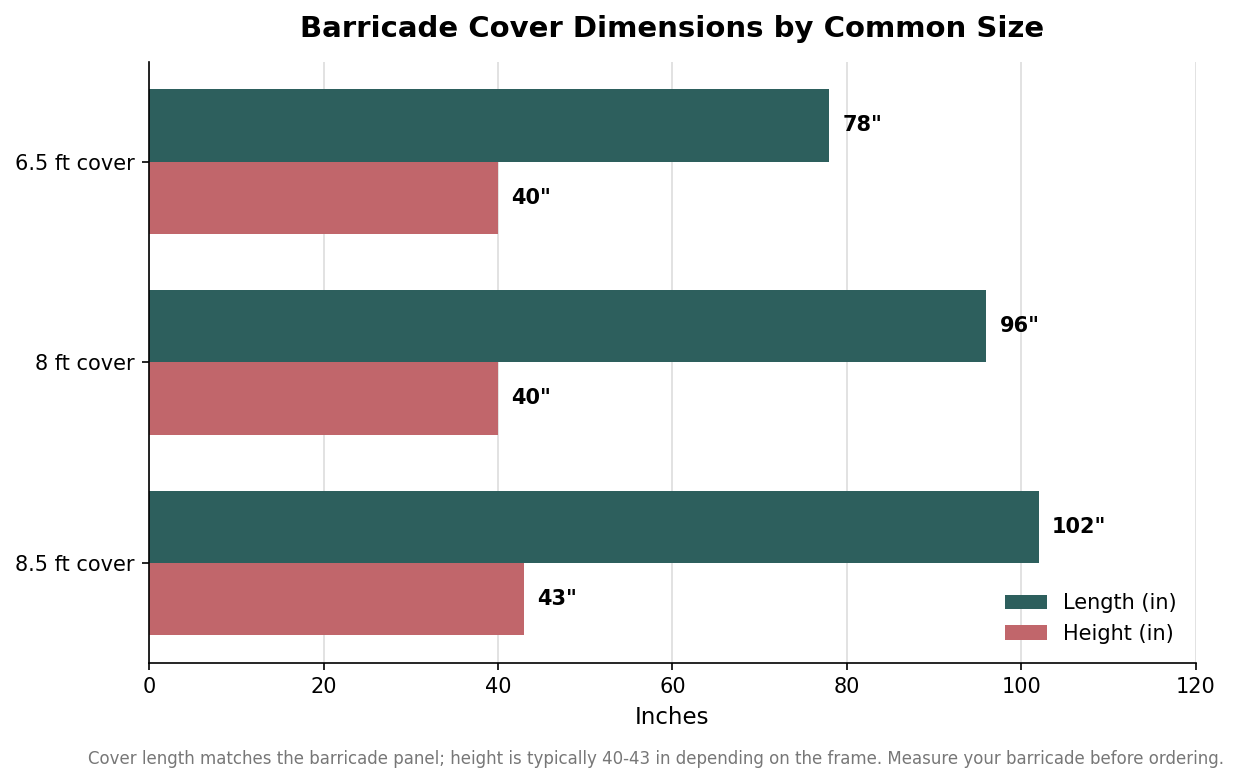
Measure the barricade you will actually use, not the catalog listing, and record the overall length, the height to the top rail, and the depth of the top rail the cover has to wrap. If your barricades come from more than one supplier or era, measure a sample of each, because a quarter-inch of frame variation across a hundred units becomes a visible problem on camera. When in doubt, most cover printers will fit to a photo and detailed measurements rather than a stock size, and that path is worth the extra step.
Choosing Solid Vinyl When the Site Is Windy
Fabric weight and openness are the difference between a cover that survives a gusty afternoon and one that turns your barricades into sails. Lighter woven polyester banner material runs around 130 grams per square meter, elastic knit polyester covers are closer to 240 grams per square meter, and heavy blockout PVC vinyl is heavier still. Heavier, solid fabric blocks the view behind the barrier almost completely, which is exactly what a construction hoarding wants, but it also catches the most wind.
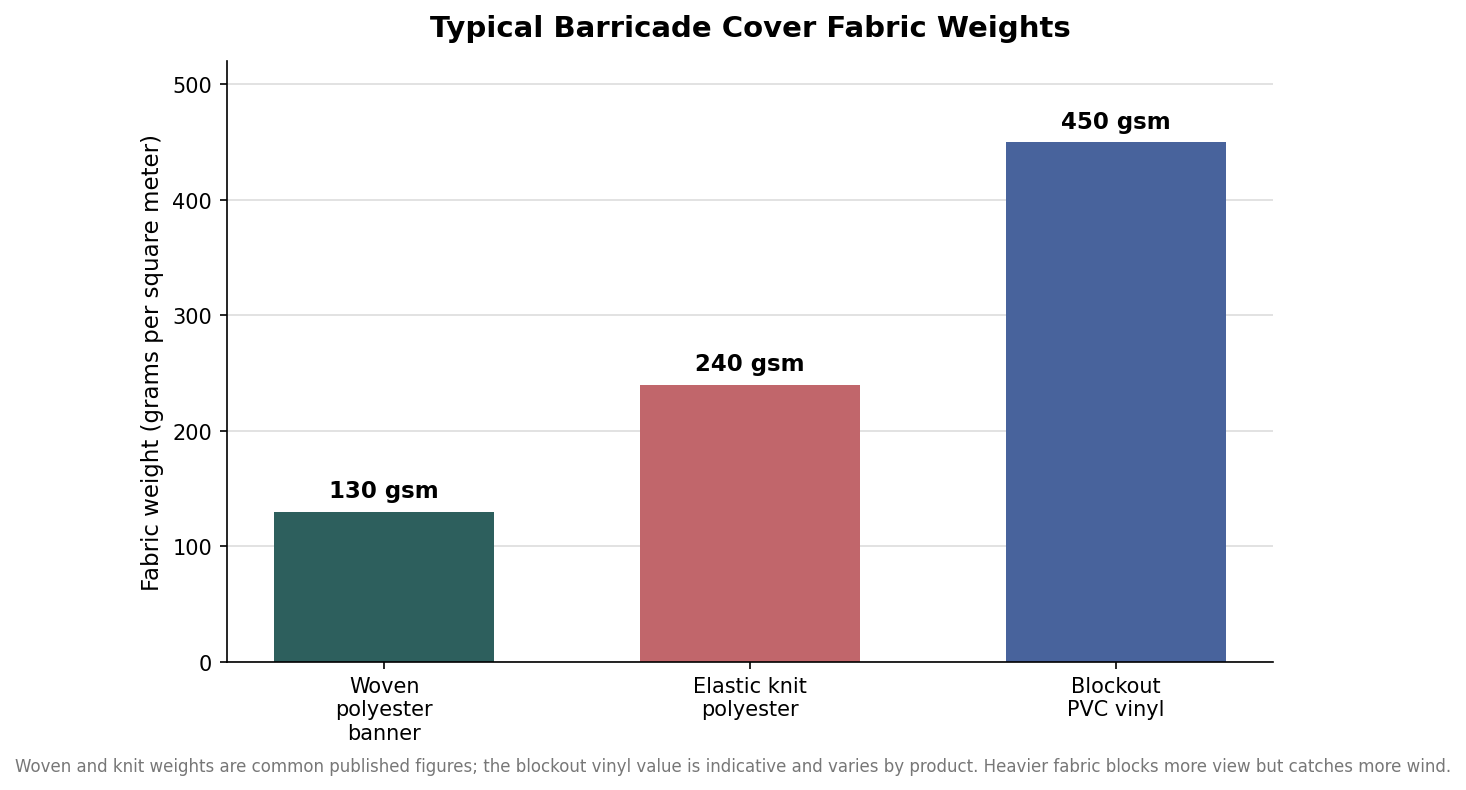
On an exposed outdoor site, a solid cover with no way to relieve wind can lift the barricade, drag it, or tear at the attachment points. The fixes are well established: choose a mesh or knit fabric that lets air pass, or specify wind slits cut into a solid cover so gusts vent instead of pushing. If full opacity is non-negotiable, then the barricades themselves need ballast or staking to hold the extra load. The mistake is pairing the most solid fabric with the most exposed location and no wind strategy at all.
Under-Speccing Attachment and Reinforcement
Covers do not usually fail in the field; the edges do. A cover held on by a couple of ties at the corners will billow in the middle and abrade at the contact points until it tears. Better covers use a combination of reinforced hems, grommets on a regular spacing, and elastic bungee balls or hook-and-loop straps that pull the fabric taut against the frame, and some add half-moon cutouts at the corners so crews can grip and stretch the cover into place. If your event runs multiple days, that reinforcement is what determines whether the covers look sharp on day three or shredded.
Think about installation labor too, because a cover that fits perfectly but takes four people to wrestle on is a hidden cost at a large build. Sleeve-style covers that slide over the top rail install fast but need clear rail ends, while grommet-and-tie systems are more forgiving of odd frames but slower. Match the attachment method to how many barricades you are dressing and how much time the crew has before doors open.
Ignoring the Fire Rating Until the Marshal Arrives
Indoor and many permitted outdoor events require flame-retardant materials, and the relevant standard for decorative fabrics and films in the United States is NFPA 701. Order covers in a non-rated fabric for a venue that requires certification and you can lose the entire run at inspection, with no time to reprint. Many barricade cover fabrics are sold specifically as flame-retardant polyester for this reason, so the fix is simply to confirm the fire rating in writing before you order and to keep the certification documentation with the covers on site.
Do not assume a fabric is rated because it is sold for events. Ask the printer to state the standard the material meets and to supply the certificate, and check your venue contract for the specific requirement, since some jurisdictions and venues have their own language on top of NFPA 701. This is a five-minute conversation at order time that prevents a total loss on show day.
Treating Both Sides as an Afterthought
Barricade covers are frequently seen from both sides, the public side and the interior of the secured area, yet buyers often design only the front. Full-color printing on both sides is widely available, and the back is prime space for sponsor logos, wayfinding, or a schedule that staff inside the perimeter actually need. If you only print one side, at least confirm what the blank back will look like from the crowd, because a plain white or seamed reverse facing a camera position undercuts the whole branded look.
Plan artwork at the real finished dimensions with edge-to-edge coverage and a safe margin so text is not lost in the hem or behind the top rail. UV-resistant inks matter for anything living outdoors for more than a weekend, since unrated inks fade and chalk. Lock the fabric, the fit, the fire rating, and the two-sided artwork before you approve the proof, and the covers that arrive will be the ones you actually planned instead of a set of expensive lessons.