Two barricade covers can carry the same artwork and behave completely differently on site: one stays crisp through a three-day festival in gusting wind, the other flogs itself to shreds by the second afternoon. The difference is almost always the substrate. Before you argue about color or price, it is worth understanding the material families a printed barricade cover can be built on, because that single choice sets your wind behavior, your lifespan, and whether the cover is a throwaway or something you reuse for years.
The three substrate families
Nearly every printed cover falls into one of three groups. Solid scrim vinyl is a coated PVC banner material that blocks wind and light completely and takes a dense, saturated print. Perforated mesh is the same idea with holes: a woven or knitted surface, part solid and part open, that lets air pass through. Knitted polyester fabric is a softer, dye-sublimated cloth that drapes over a barricade and is typically launderable and reusable. The chart below places the common options against the two variables that matter most outdoors, how much air they let through and how long they last.
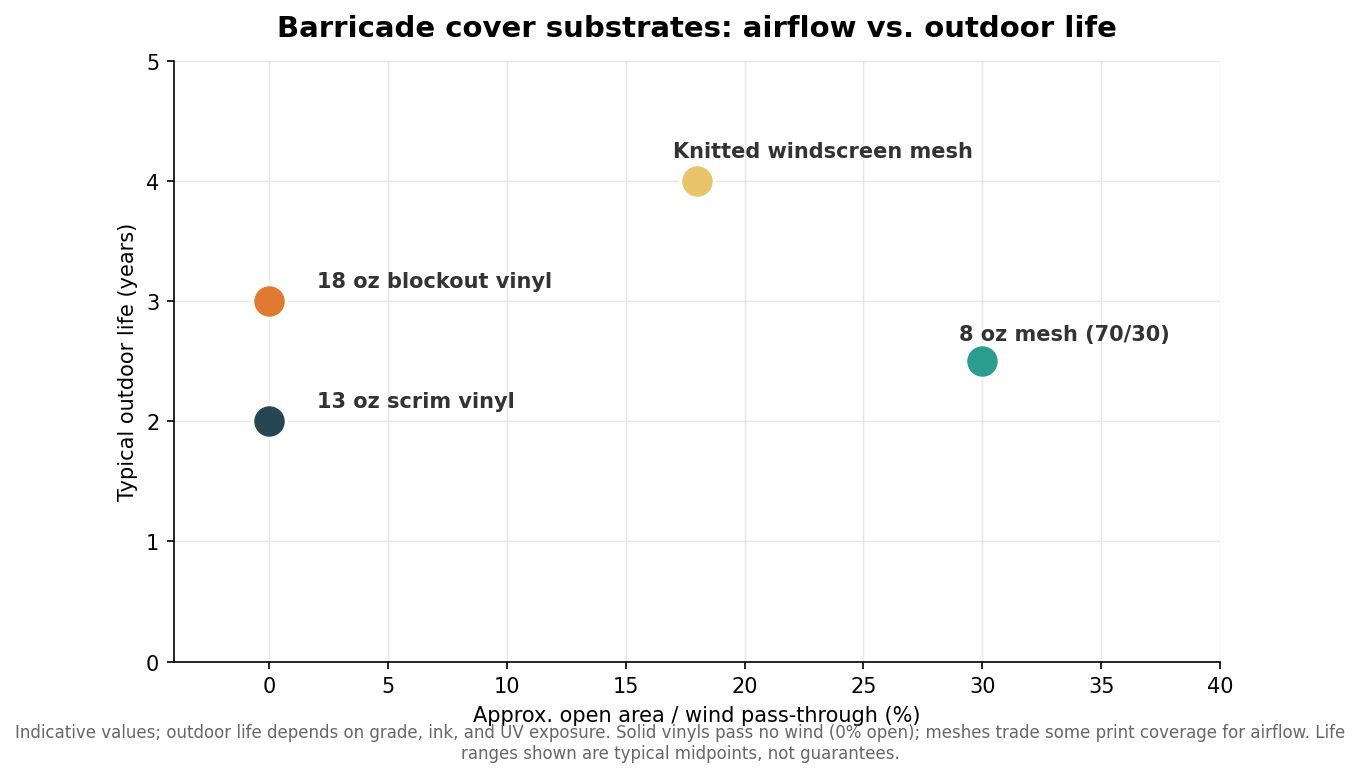
Read that trade-off from left to right: the solid vinyls sit at zero open area, so they show the boldest graphics but catch the most wind, while the meshes give up some of that print surface in exchange for airflow. Nothing here is universally best; the right pick depends on where the barricade stands and for how long.
Solid scrim vinyl: bold print, no airflow
For indoor events, short outdoor runs, and anywhere wind is not the enemy, solid vinyl is the workhorse. Thirteen-ounce scrim vinyl is the common event weight: a matte, eco-solvent-printed banner material with vivid color, a typical outdoor life around two years, and a price that suits covers you may only run a handful of times. Step up to eighteen-ounce blockout vinyl when you need true opacity, a core layer stops light and any ghosting of what sits behind the barricade, and the heavier construction pushes usable life closer to three years for more permanent placements. Both share the same limitation: they pass no wind at all, so a large solid cover on an exposed barricade needs ballast or a rail that can take the load, or it becomes a sail. A bare bike-rack barricade is mostly open air and barely catches the wind; wrap it in solid vinyl and you have turned that open frame into a continuous panel, which is why event crews tend to reserve solid vinyl for indoor and short outdoor runs and reach for mesh the moment a job moves outside for more than a day or sits in an exposed spot.
Perforated mesh and why open area matters
Mesh exists to solve the wind problem. A common event mesh is described as a 70/30 construction, roughly seventy percent solid surface and thirty percent open area, which lets about a third of the wind pass straight through while still holding a readable print. Purpose-built windscreens push further, blocking anywhere from about eighty to ninety percent of the wind for general use and staying in the seventy-to-eighty-five-percent block range where high winds are the design concern. The rule of thumb is simple: more open area means less wind load and less ink coverage. The stacked view below shows how the solid-to-open ratio shifts across materials.
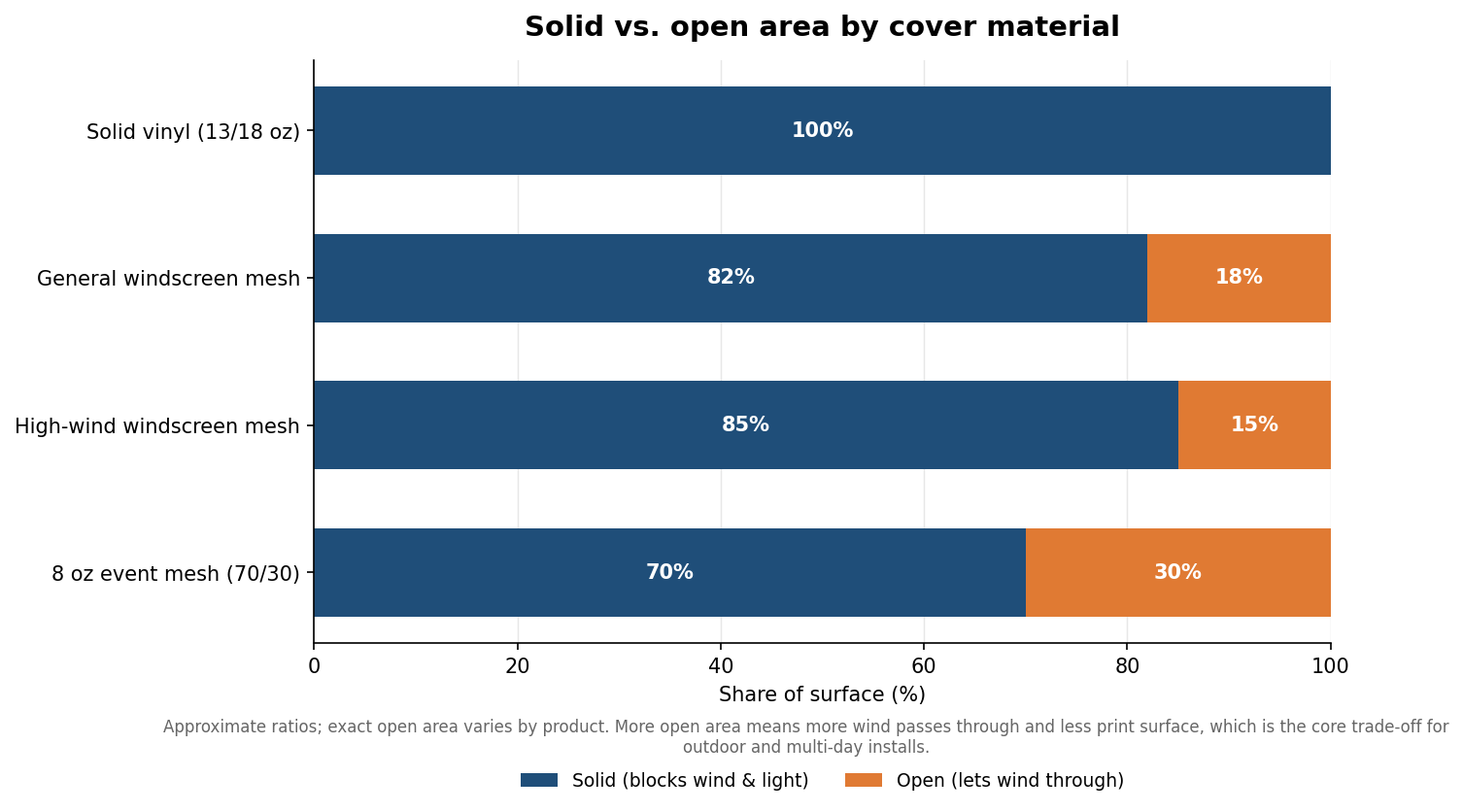
Because a mesh cover breathes, it can run larger and longer on an exposed fence line than solid vinyl of the same size. Knitted polyethylene windscreen commonly lasts three to five years, and heavier vinyl-coated constructions longer still, though the print on any outdoor surface fades faster than the fabric fails. Attachment matters as much as the fabric here: grommets set every twelve to eighteen inches, laced with zip ties, bungees, or rope, keep the load spread, and a tension cable is worth adding on any run longer than about fifty feet.
Knitted fabric covers: reusable and tailored
The third family trades some ruggedness for finish and reuse. Dye-sublimated polyester knit produces a soft, edge-to-edge print with no seams in the image, and because the dye is infused into the fiber it survives repeated laundering. That makes fabric covers the choice for a brand that reuses the same barricades across a season of events, or for premium finishes where a fitted, wrinkle-shedding cover reads better than a flat banner. The compromises are cost per piece and durability against abrasion and sharp barricade corners, so fabric tends to belong to managed, reused fleets rather than leave-it-and-forget-it construction sites. It is also worth confirming how a fabric cover is cut and sewn: a fitted, pocket-and-flap cover that slips over the top rail and cinches at the base stays put far better than a flat panel zip-tied to the front, and that tailoring is a large part of what you pay for on the fabric side.
Matching material to the job
Line the choice up with the setting. For an indoor expo or a one-weekend activation, 13-ounce scrim vinyl gives the most color for the least money. For a permanent perimeter that must block sightlines, 18-ounce blockout earns its cost. For any exposed, multi-day, or windy outdoor line, choose mesh and size the open area to the wind you expect rather than defaulting to solid. And for a reusable, on-brand fleet you will deploy again and again, a dye-sublimated fabric cover pays back over its life. One spec sits above all of these and is chosen separately: if your venue requires a flame rating, confirm the material carries the certificate you need, since fire performance is a property of the specific product, not of the substrate family as a whole.