A printed barricade cover looks like a simple banner wrapped around a steel barrier, but two invisible forces decide whether it survives an event: the wind trying to tear it loose, and the fire code deciding whether it is allowed on site at all. Brand and design get most of the attention, yet a cover that ignores wind and flame rules can fail on the first gusty afternoon or get pulled by a fire marshal before doors open. Understanding both constraints up front lets you specify a cover that holds up and passes inspection, instead of learning the rules the hard way.
Why wind is the first design constraint
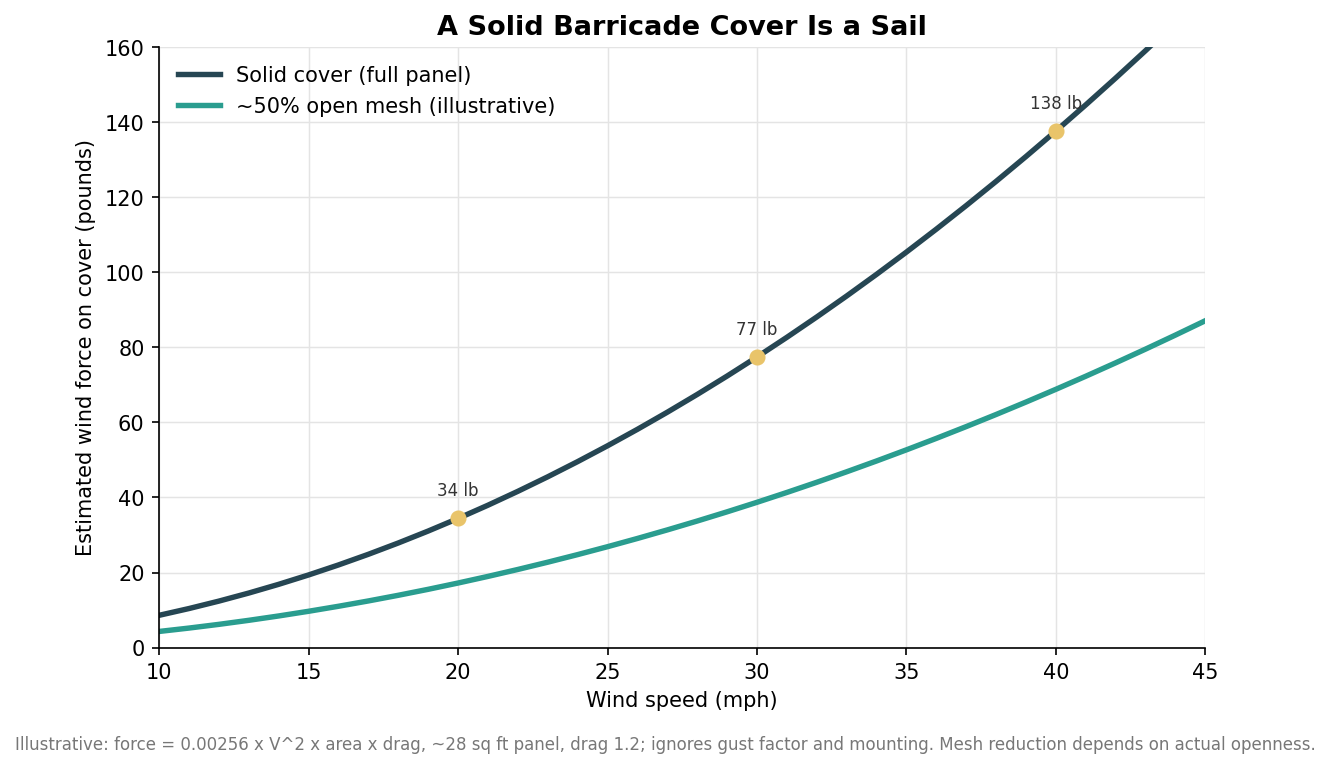
A barricade cover is a broad, flat surface mounted on a light, freestanding frame, which is a nearly perfect description of a sail. The wind force on that surface climbs with the square of wind speed, so doubling the wind roughly quadruples the load. On a typical panel of about eight feet by three and a half feet, a solid cover can catch tens of pounds of force in a moderate breeze and well over a hundred pounds as gusts strengthen. The barricade itself weighs little and is not anchored, so beyond a certain point the wind either topples the barrier, drags the line, or rips the cover at its attachment points. The figures below are illustrative rather than an engineering certification, because real loads depend on gusts, mounting, and the exact fabric, but the shape of the curve is the point: force grows fast, and a solid cover feels it first.
Mesh, openness, and airflow
The standard answer to wind is to let some of it through. Mesh fabric is woven with open space between the yarns so air passes rather than pushing against a solid wall, and the more open the weave, the less area the wind actually acts on. A cover that is fifty percent open presents roughly half the wind-facing area of a solid one, and a high-flow seventy percent mesh less still. That is why outdoor festivals and raceside barriers lean on mesh while indoor, low-wind settings can use denser solid fabrics that show color more vividly. The trade-off is print appearance: a more open mesh scatters the image slightly and lets background show through, so very fine detail and deep solid colors read better on tighter weaves. The practical middle ground for most outdoor branding is a mesh open enough to shed wind but tight enough to hold a clean logo, and reputable suppliers will quote an airflow or openness rating so you are not guessing.
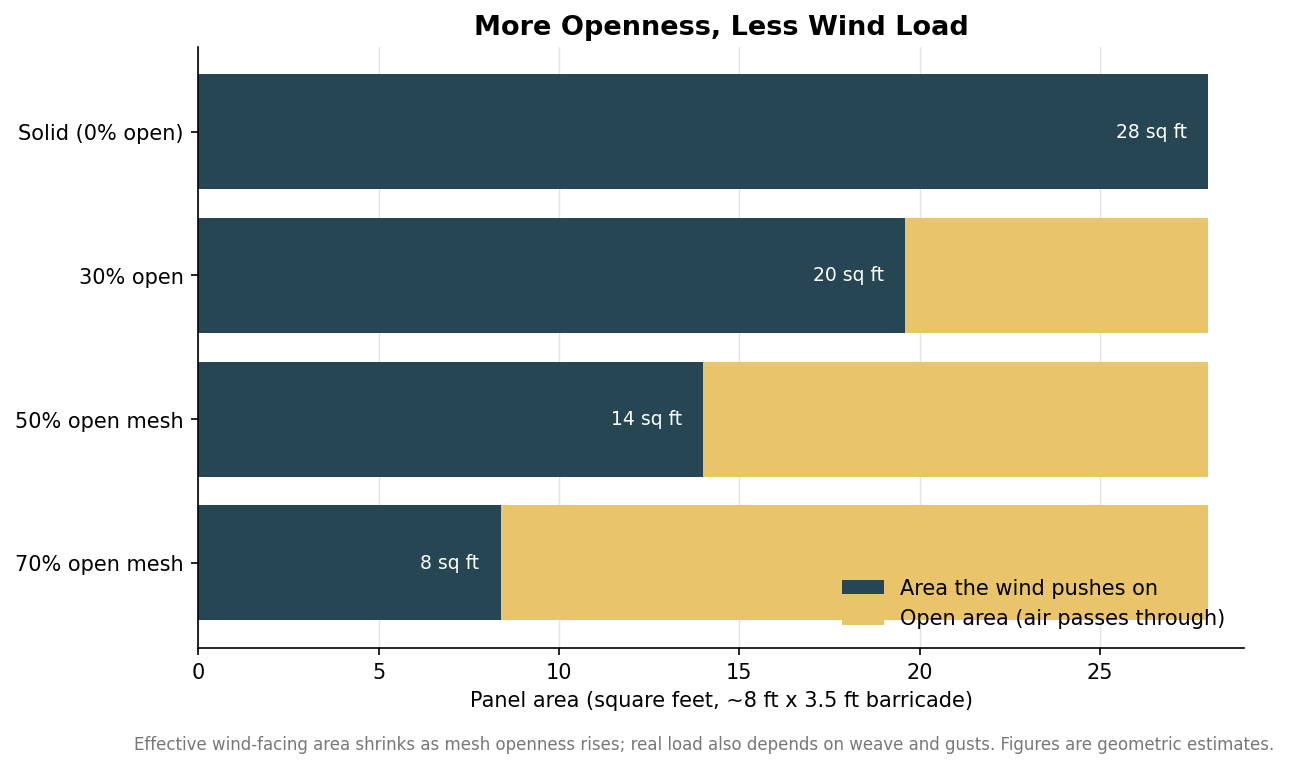
Openness is a wind strategy, not a guarantee. Even a good mesh needs sound mounting, and in genuinely high winds the right call is sometimes to remove covers entirely rather than trust the fabric. Treat mesh as the measure that keeps ordinary breezes from becoming a problem, not as permission to ignore a storm forecast.
NFPA 701 and the fire marshal
The fabric also has to satisfy fire code, and for event textiles in the United States the reference standard is NFPA 701. It is a flame propagation test: a sample is exposed to a controlled flame, and to pass it must self-extinguish rather than keep burning, with the charred length staying under about six and a half inches and any after-flame lasting no more than roughly two seconds, and any drips must not continue to burn. Passing NFPA 701 does not make a fabric fireproof; it means the material resists igniting and does not spread flame, which is exactly what a fire marshal cares about in a crowd. Many venues and jurisdictions require NFPA 701 certification, often alongside a certificate for tents and structures, before they will issue a permit, and inspectors can ask to see documentation on site. Because the certificate travels with the specific fabric, the practical step is to require it in writing from your supplier and keep the paperwork with the covers, so a question at the gate does not become a shutdown.
Sizing to standard barricades
Covers only look sharp when they fit, and most crowd-control barricades follow a fairly standard footprint. Interlocking steel barricades commonly stand around forty to forty-three inches tall, with roughly forty-three inches (about 1.1 meters) being a widely shared height across rental fleets so that panels from different suppliers interlock. Panel lengths cluster around eight feet, with metric equivalents near two and two and a half meters also in circulation. Before ordering, measure the actual barriers you will dress, including the height to the top rail and the length between uprights, because a cover cut for a 1.1 meter barrier will sag or gap on a shorter economy model. If your inventory mixes styles, tell the supplier, since a universal-fit cover and a custom-fit cover are built differently and the tighter the intended fit, the more the exact numbers matter.
Construction that survives a season
Fabric choice and fit only pay off if the cover is finished to take abuse. The details that separate a season-long cover from a single-use one are sealed, double-folded hems that resist fraying, reinforced seams, and heavy-duty grommets rather than light stamped eyelets at the tie points. Those attachment points carry the wind load, so they are exactly where a cheap cover fails first. Ask how the edges are finished, how many attachment points run along each edge, and whether the corners are reinforced, because a cover that catches even moderate wind concentrates stress there. Ties, bungees, or hook-and-loop straps should be rated for outdoor use and spaced closely enough to keep the fabric from ballooning between them.
Specifying a cover that passes
When you request a quote, put the constraints on the page alongside the artwork. Name the environment, indoor or outdoor and the kind of wind you expect; ask for a specific mesh openness or airflow rating for outdoor use; require NFPA 701 certification with documentation supplied; give the measured barricade height and length and the fit you want; and confirm the hem, seam, and grommet construction. Those five items turn a vague banner order into a cover engineered for the conditions it will face. A cover chosen on print quality alone can still fail at the barrier or the permit desk, while one specified for wind and fire from the start does its branding job precisely because nobody has to think about it during the event.