Barricade Cover Artwork: How to Design Panels That Read From the Street
Good barricade cover artwork puts one bold message in the upper middle of each panel, keeps text out of the wrap and tie zones, and plans how covers repeat side by side. Custom Barricade Covers turns your logo and copy into a free mockup within 24 hours, so you can check placement, contrast and sequence on your real barrier type before anything prints.
- Keep logos and headlines in the upper middle band, away from edges and ties
- Mesh softens fine detail; blockout holds photos and small copy
- Mix repeat, alternating, sponsor and wayfinding layouts in one order
- Free mockup within 24 hours, minimum order 12
- Standard turnaround about 2 weeks after approval
What makes barricade cover artwork different from a regular banner?
Barricade cover artwork has to work on a long, low panel that people see from the side, at walking pace, and often in a crowd. A banner hangs at eye level and gets a straight-on look. Barricade covers sit at hip height, run in a line, and are read at an angle by people moving past them, so the design rules change.
Three things set barricade covers apart. First, the shape is wide and short, so a square logo dropped in the middle leaves most of the panel empty. Second, covers are installed side by side, which means the design either repeats cleanly from one barrier to the next or breaks into awkward fragments. Third, the panel wraps around a frame with ties, sleeves or hook-and-loop closures, and anything placed over those attachment points can get hidden or creased.
When you plan artwork with those three facts in mind, the line of barriers reads as one branded wall instead of a row of mismatched signs. That is the goal Custom Barricade Covers designs toward on every free mockup.
Where should the logo go on a barricade cover?
The logo on a barricade cover belongs in the upper middle band of the panel, away from the frame edges and the attachment points. That zone stays visible above crowd legs, strollers and coolers, and it survives the slight curve where the material wraps the top rail.
For a single logo, center it horizontally and give it generous space on both sides. For a sponsor wall, place marks in an even rhythm across the width so each one lands on a flat section of the panel. Avoid the bottom strip entirely for anything important; that area collects mud, splashes and boot scuffs at outdoor events.
Safe zones to keep clear
- Frame edges: the outer border wraps around tubing or rails, so text placed there bends out of view.
- Grommet and tie points: holes and ties can cut through a letter or a sponsor mark.
- Feet and bases: on bike-rack and French barriers, the lower corners sit close to the steel feet.
- Seams between barriers: the gap where two covers meet should never split a word or a logo.
Custom Barricade Covers marks these zones on every mockup so you can see exactly where your logo sits before anything is printed.
How big should text be on barricade covers to read from a distance?
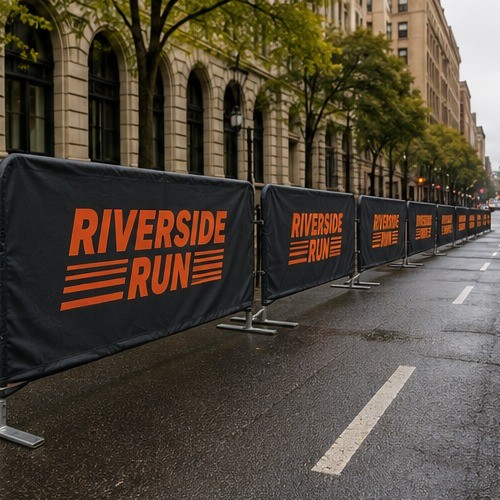
Text on barricade covers should be as large as the panel allows, with short words and heavy letterforms. A barricade line is usually read from across a street, a parking lot or a stadium concourse, so thin script fonts and long sentences disappear quickly.
A useful test is the walk-past test: if a person moving at normal pace cannot catch the message in a glance, the copy is too long or too small. Keep each panel to one idea, such as the event name, a single sponsor, an entry instruction or a short slogan. Save web addresses and social handles for a smaller secondary line, and only include them if they are short.
- Use bold or semibold sans-serif type for anything that must be read on the move.
- Limit each cover to one headline and, at most, one supporting line.
- Pick strong contrast: dark text on a light field or light text on a dark field.
- Skip outlined or hairline type, which breaks up on mesh material.
If you are unsure what will read well, send your draft copy and the designers at Custom Barricade Covers will lay it out at real panel proportions in the 24-hour mockup.
Should every barricade cover in a run have the same design?
Barricade covers do not all need the same design, and many of the strongest orders mix two or three layouts in one run. A repeating design is the simplest choice and looks clean along a long fence line. A sequenced design changes from panel to panel so the line tells a story or carries several sponsors.
| Layout approach | How it works | Best for |
|---|---|---|
| Single repeat | Every cover carries the same artwork | Construction sites, brand walls, simple event perimeters |
| Alternating pair | Two designs swap back and forth down the line | Event name plus a title sponsor, or brand plus a message |
| Sponsor sequence | Each cover features a different sponsor or tier | Finish lines, festival entries, game-day gates |
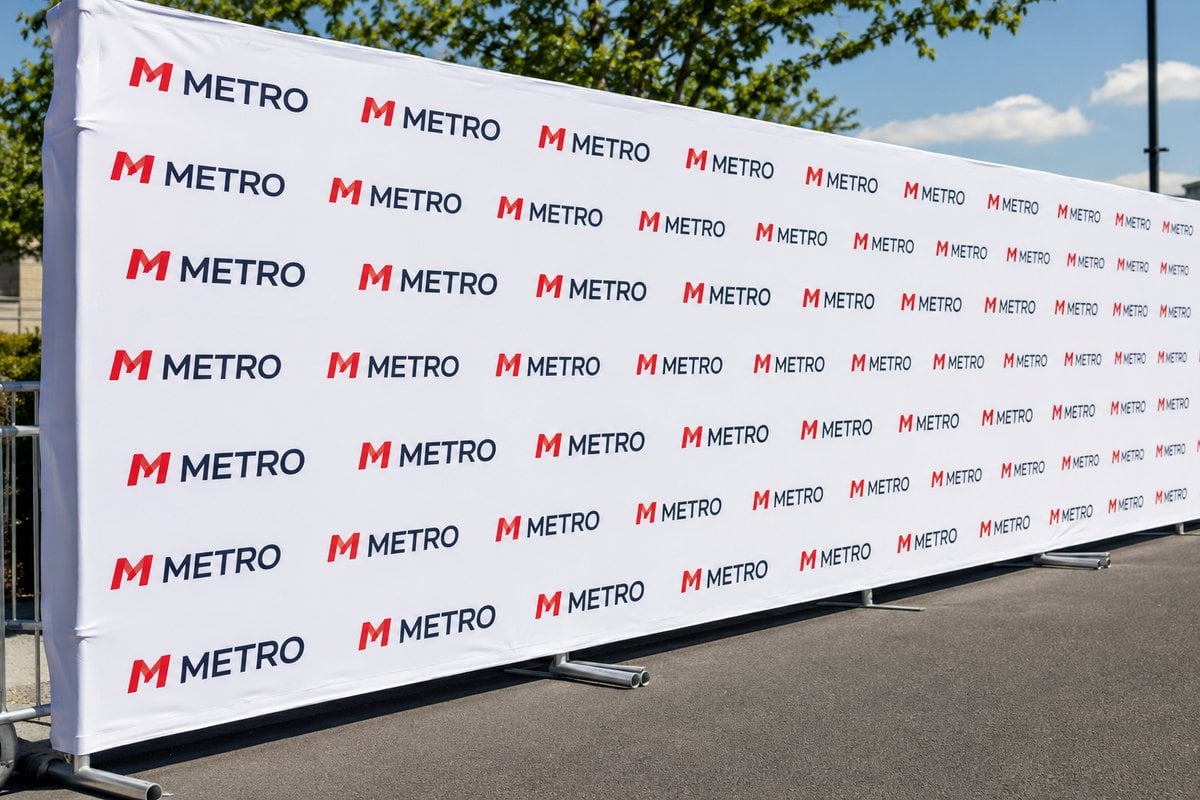
| Continuous mural | One wide image split across several covers in order | Media areas and step-and-repeat backdrops |
| Wayfinding set | Each cover carries its own instruction or direction | Entry lanes, ADA routes, will-call and exits |
Continuous murals look impressive but depend on the barriers being installed in the right order every time, so number the covers on the back or in a corner. For a deeper look at backdrop layouts, see the step-and-repeat barricade covers page.
How does the cover material change what your artwork should look like?
The cover material changes how colors, fine detail and small text come across, so artwork should be tuned to the style you order. Mesh barricade covers let wind and light pass through tiny openings, which softens fine lines and lightens solid fills. Blockout barricade covers print on a solid surface and show crisp detail and deep color.
On mesh barricade covers, simplify. Use bold shapes, larger logos and fewer thin elements. Photographs work, but busy backgrounds can turn muddy. On blockout barricade covers, you can use full-bleed photography, gradients and smaller secondary copy with confidence, which is why sponsor walls and media zones usually choose blockout.
Water barriers and jersey barriers are a different shape again: a sleeve hugs a sloped or rounded form, so the readable face is narrower than the full print area. Keep the key message on the flattest part of the barrier. The water-barrier and jersey barrier covers page shows how those sleeves sit.
A-frame barricades show two faces. Decide early whether both sides carry the same artwork or whether the back face carries a different message for traffic coming the other way.
What artwork mistakes show up most often on barricade covers?
The most common barricade cover artwork mistakes are small logos, text placed in the wrap zones, low-contrast color pairings and low-resolution images pulled from a website. Each one is easy to fix at the mockup stage and expensive to live with after the covers arrive.
- A square logo on a wide panel. Stretch the layout, not the logo: add a color band, a pattern or a tagline to fill the width.
- Copy in the bottom third. Crowds, bags and splashes hide anything near the ground.
- Light gray on white, or navy on black. Contrast that looks fine on a laptop disappears outdoors in bright sun.
- Screenshots and social graphics. Images made for a phone screen fall apart at barricade size. Vector logos give the cleanest edges.
- Sponsor marks at mismatched sizes. Uneven logos look like an oversight. Agree on tier sizes before the mockup.
- Dates that expire. A year on the panel ends reuse after one event. Leave dates off if you plan to bring the covers back.
Custom Barricade Covers checks every file for these issues and flags them on the mockup, and revisions are unlimited and free, so nothing goes to print until you are happy with it.
How do you get a barricade cover mockup approved quickly?
The fastest way to get a barricade cover mockup approved is to send everything in one request: your logo files, the barrier type, the number of covers, the layout approach and the names of everyone who must sign off. Custom Barricade Covers returns a free mockup within 24 hours, and the order only moves to production after you approve it.
- Submit the quote form with your barrier type and quantity, from a minimum of 12 covers.
- Attach logos, brand colors and any sponsor marks, plus a note on which layout you want.
- Review the mockup with your stakeholders and send consolidated feedback in one reply.
- Approve the final proof; standard turnaround is about 2 weeks, with faster turnaround available through express shipping.
Collecting feedback from sponsors, legal and operations before you reply prevents back-and-forth rounds that eat into your event timeline. You pay nothing until the design is approved. The how it works page walks through the full process, and city teams planning parades or street closures can find layout ideas on the municipal events page.
Frequently asked questions
Can one barricade cover order include several different designs?
Yes, one barricade cover order can include several designs, such as an event name panel, a title sponsor panel and a wayfinding panel. Custom Barricade Covers lays each version out on the mockup so you can see how the line looks installed. Many buyers alternate two designs along a fence line, which keeps the perimeter varied without making it look cluttered or random.
Should text on barricade covers avoid the edges of the panel?
Barricade cover text should stay well inside the panel edges because the border wraps around rails, tubing or barrier frames. Words placed near the outer edge bend out of sight or get crossed by ties and grommets. Keep headlines and logos in the upper middle band, and leave the edges for background color, patterns or simple brand stripes.
Do photographs work well on mesh barricade covers?
Photographs can work on mesh barricade covers, but the small openings in the material soften fine detail and lighten dark areas. Bold, high-contrast images with a clear subject hold up best. If a photograph is the centerpiece of the design, a blockout barricade cover usually gives sharper results, while mesh suits logos, simple graphics and windy sites.
How can a continuous image stay in order across many barricade covers?
A continuous image across barricade covers stays in order when each cover is numbered in a small, discreet spot, such as a lower corner or the reverse side. Crews then install the barricade covers left to right by number. Custom Barricade Covers can add those sequence markers to the artwork so the mural lines up at every event.
What contrast works best for barricade covers seen in bright sun?
Barricade covers seen in bright sun need strong contrast between text and background, such as white on navy, black on yellow or dark green on cream. Pale pairings like light gray on white wash out outdoors. Custom Barricade Covers reviews contrast on the mockup and suggests adjustments when brand colors might be hard to read from the street.
Can the back of an A-frame barricade cover carry a different message?
An A-frame barricade cover can carry a different message on each face, which is useful when traffic approaches from both directions. One side might show a sponsor while the other gives a detour or entry instruction. The mockup from Custom Barricade Covers shows both faces side by side so you can confirm each message before printing.
Is a website screenshot good enough as barricade cover artwork?
A website screenshot is rarely good enough for barricade cover artwork because screen images are built for small displays and blur when enlarged to barrier size. Vector logos or high-resolution originals print much more cleanly. When only a screenshot exists, the design team at Custom Barricade Covers can advise on recreating the mark so it stays sharp across the panel.
How should sponsor logos be sized relative to each other on barricade covers?
Sponsor logos on barricade covers should be sized by agreed tiers so that equal partners get equal visual weight. A title sponsor might get its own full panel, while supporting sponsors share panels at a matching size. Settling tier sizes before the mockup avoids disputes and gives every partner a clear, fair spot on the barricade line.
Can barricade covers include QR codes?
Barricade covers can include QR codes, but the code needs to be large, high-contrast and placed at a height where people can stop and scan it safely. Mesh material can reduce scan reliability, so blockout barricade covers are the better choice for QR-heavy designs. Test the code from the mockup on a phone before approving.
Should barricade cover artwork leave room for future sponsors?
Barricade cover artwork can reserve a blank or neutral area for future sponsors, but empty space often looks unfinished on the day. A better approach is to print evergreen brand covers and order a smaller run of sponsor-specific covers each season. Custom Barricade Covers can match the look of earlier batches so new and old covers sit together neatly.
Does the barrier type change how barricade cover artwork is laid out?
The barrier type changes barricade cover artwork because each frame exposes a different readable area. Bike-rack and French barriers show a wide, flat face, water and jersey barriers curve, and A-frames show two sloped sides. Tell Custom Barricade Covers which barriers you own and the mockup will place logos and text where they stay flat and visible.
What is the fastest way to give feedback on a barricade cover mockup?
The fastest way to give feedback on a barricade cover mockup is one consolidated reply that lists every change from all decision makers. Mark changes by panel, such as panel two logo larger or panel four new headline. Revisions are free and unlimited, but a single combined round keeps the barricade covers on track for about 2 weeks of production.
Get a free mockup for your barricade covers
Send your logo or idea and the quantity you have in mind. Custom Barricade Covers returns a free mockup within 24 hours, you approve the design before anything is produced, and standard turnaround is about two weeks with faster options available. Get a custom quote.