Barricade Covers vs. Zip-Tied Banners: Which Is Better for Your Event?
Barricade covers beat zip-tied vinyl banners for most events that use standard barriers, because a fitted cover turns every barrier into one continuous branded wall that installs faster, handles wind better and lasts for repeat events. Custom Barricade Covers builds covers for bike-rack, French, water-barrier and A-frame hardware, and this guide explains when a banner still makes sense.
- Barricade covers fit bike-rack, French, water-barrier and A-frame barriers
- Mesh covers let wind pass through the print
- Free mockup within 24 hours, unlimited free revisions
- Minimum order of 12 barricade covers, styles can be mixed
- Standard turnaround about 2 weeks after approval
What is the difference between barricade covers and zip-tied vinyl banners?
Barricade covers are printed sleeves or panels cut to the shape of a specific barrier, such as a steel bike-rack barricade, a French barrier, a plastic water barrier or an A-frame, and they attach with sewn-in fastening so the print sits flat across the whole frame. A zip-tied vinyl banner is a generic rectangle with grommets that someone lashes to whatever barrier is available on the day.
Both put a message on a barrier, but they solve different problems. A banner is a sign that happens to hang on a fence. A barricade cover turns the barrier itself into the sign, so a run of covers reads as one continuous branded wall rather than a series of separate rectangles with gaps between them. Custom Barricade Covers builds each cover to the barrier type you name on the quote form, which is why the first question on any order is what hardware you will be covering.
- Barricade covers: fitted to the barrier, edge to edge, designed to be installed in a long matching run.
- Zip-tied banners: one size fits most, mounted with ties through grommets, usually covering only part of the frame.
Which looks more professional on camera and from the street?
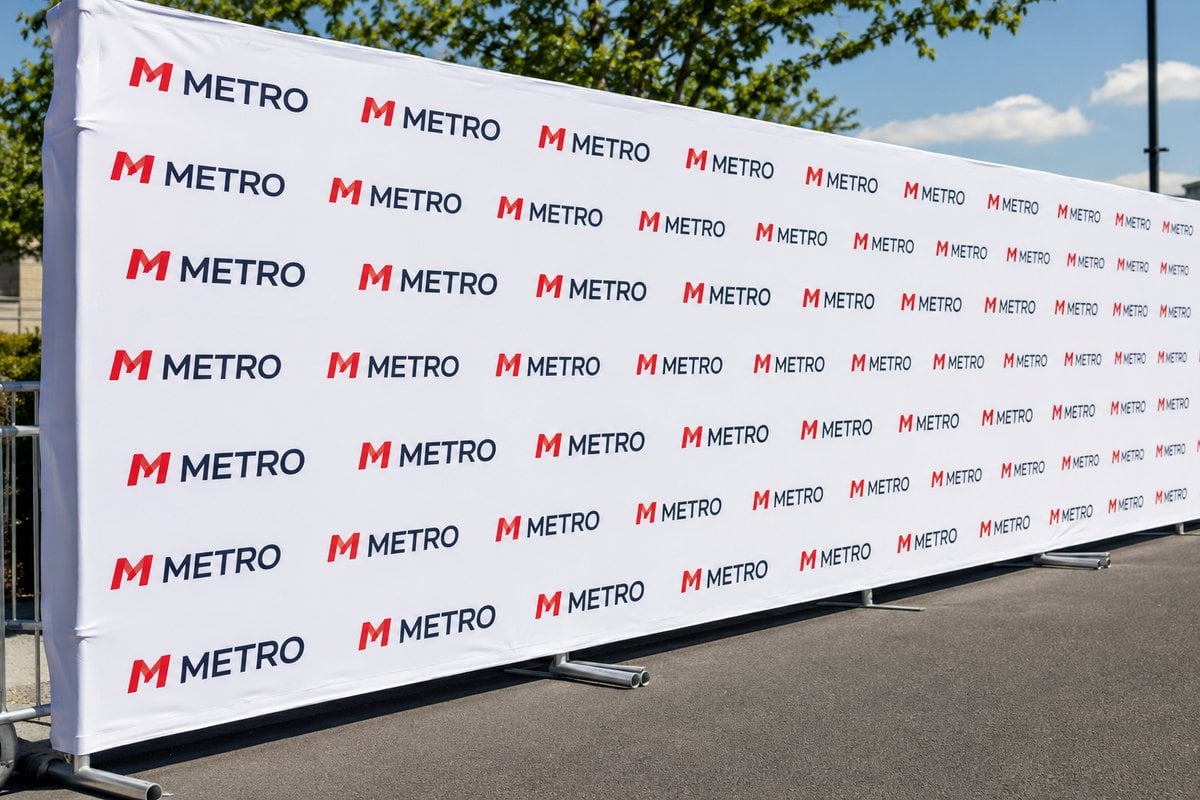
Barricade covers look more professional in almost every setting, because a fitted cover has no sagging corners, no exposed steel above or below the print and no stray zip-tie tails. When a broadcast camera pans down a finish chute or a guest photographs a VIP entrance, a run of covers reads as a single designed surface, while banners read as a patchwork.
Banners also tend to drift. Each one is tied by whoever is on the setup crew, so heights and spacing vary from barrier to barrier and the logo lands in a slightly different spot every time. Covers built to the same template put the logo in the same place on every panel, which matters most on step-and-repeat media walls and continuous sponsor runs where the eye notices any break in the pattern.
If your event is photographed, streamed or covered by press, that consistency is the main reason to choose covers. The step-and-repeat barricade covers and blockout barricade covers are built for exactly those camera-facing spots.
Are barricade covers or banners better in wind?
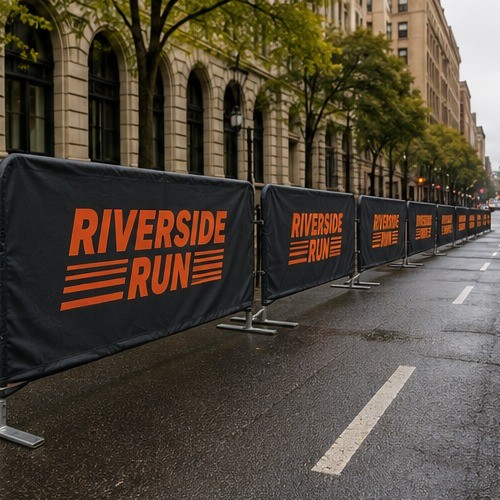
Barricade covers usually handle wind better than zip-tied banners, because a fitted cover is anchored along its full edge rather than at a handful of grommets. A banner tied at the corners acts like a sail: it billows, pulls on the ties, tears at the grommets and can tip a lightweight barrier on an exposed site.
Material choice matters as much as format. Mesh barricade covers let air pass through the print, which is why they are the usual pick for open parking lots, waterfront courses and long festival perimeters. Solid blockout material gives the boldest color and full privacy, and it performs best where barriers are weighted, linked together or sheltered by buildings. A solid vinyl banner on a single unlinked barrier is the setup most likely to fail on a gusty day.
| Setup | How it behaves in wind |
|---|---|
| Mesh barricade cover | Air passes through; lowest load on the barrier |
| Blockout barricade cover | Full print surface; best on linked or weighted runs |
| Solid vinyl banner, zip-tied | Catches wind at the ties; grommets and ties are the weak point |
Which is faster to install and take down?
Barricade covers are faster to install at scale, because every cover goes on the same way and there is nothing to measure, center or cut on site. A crew slides or wraps the cover over the barrier, secures the fastening and moves to the next one. Zip-tied banners need each tie threaded, pulled and trimmed, and every one has to be cut off again at teardown.
The difference grows with the length of the run. On a dozen barriers either option is manageable. On a marathon finish area, a parade route or a stadium perimeter, cutting and replacing hundreds of zip ties adds real labor to load-in and load-out, and it creates a pile of plastic waste every time. Covers come off intact and stack for the next event.
Banners do have one advantage: they can be hung on almost anything, including chain-link fence, scaffolding and railings. If your event has no barricades at all, a banner may be the right product. If it has bike-rack barriers, French barriers or water barriers, covers made for that hardware will go up faster.
Which costs less over the life of the event program?
Barricade covers often deliver more value over time, even though a banner can look like the simpler purchase for a single day. The real cost of either option is driven by how many barriers you cover, which material you choose, whether the print is one-sided or two-sided, how many different designs are in the order, and how many times you will reuse the set.
Covers are built to come off clean and go back on, so a recurring race, a weekly market or a full sports season can run on one set. Banners lose ties and grommets each time they are removed, and a banner that has been retied a few times rarely looks new. When you compare quotes, ask what the per-event cost looks like across the whole season, not just the first event. Custom Barricade Covers does not publish a price list because those variables change every order; the quote form returns a number for your exact count, styles and artwork.
- Barrier count and barrier type
- Mesh, blockout or step-and-repeat material
- One-sided or two-sided printing
- Number of distinct designs in the run
- How many events the set must survive
When does a zip-tied banner still make sense?
A zip-tied banner still makes sense when the barrier is not a standard barricade, when you need a single sign rather than a branded run, or when the message is truly one-day-only. Chain-link construction fence, scaffolding, stage railings and pipe-and-drape frames are all better served by a banner than by a cover made for a bike-rack barrier.
Banners are also a reasonable choice for a one-off message that will be thrown away, such as a specific date or a temporary closure notice. For anything that repeats, is sponsored, or sits in front of cameras, the covers usually win. Many organizers mix the two: covers on every barricade along the route and a few banners on the fences and structures that are not barricades.
If you are not sure which barriers your venue or rental company supplies, ask before ordering. A photo of the barrier is enough for Custom Barricade Covers to confirm which style fits.
How do you choose between barricade covers and banners for your event?
Choose barricade covers when you have a run of standard barriers, care how the event looks in photos, expect wind, or plan to reuse the set. Choose banners when the structure is not a barricade or the message is a single throwaway sign. The quickest way to decide is to answer five questions about the event before you ask anyone for a quote.
- What hardware is on site? Bike-rack, French, water barrier or A-frame barriers all have a matching cover style; fences and scaffolding point to banners.
- How long is the run? Long runs favor covers for speed and a continuous look.
- Will it be on camera? Media walls, finish lines and VIP entries favor fitted covers.
- How exposed is the site? Open, windy sites favor mesh covers.
- Will it come back? Recurring events favor covers you can reinstall season after season.
Once you know the answers, send your barrier count and type, artwork and event date through the quote form. The minimum order is 12 barricade covers, and styles can be mixed in one order.
What happens after you order barricade covers?
After you order, Custom Barricade Covers sends a free mockup within 24 hours showing your artwork on the barrier style you chose, and you can request unlimited free revisions until every panel is right. You pay nothing until you approve the design. Standard turnaround is about 2 weeks after approval, with faster delivery available through express shipping.
The mockup stage is where a cover order pulls ahead of a banner order. Because the cover is built to a known template, the mockup shows exactly where the logo, sponsor marks and wayfinding will sit on the barrier, including how a continuous image lines up from panel to panel. With a banner, the final look depends on how the crew ties it on the day.
The full process is laid out on the how it works page, and the custom barricade covers page shows every style available.
Frequently asked questions
Can barricade covers go on the same barriers we currently use for zip-tied banners?
Barricade covers fit standard steel bike-rack barriers, French barriers, plastic water barriers and A-frames, which are the same barriers most events already use for zip-tied banners. Send a photo or the barrier type with your quote request, and Custom Barricade Covers will confirm which cover style matches your hardware before the free mockup is made, so nothing needs to be replaced on site.
Do barricade covers leave gaps between barriers the way banners do?
Barricade covers are built to the full face of each barrier, so a linked run of covers shows far smaller gaps than a row of zip-tied banners. Artwork can also be planned to continue from one cover to the next, which makes the gaps that remain read as part of the design. The mockup shows how the run will look before anything is printed.
Is it worth replacing existing vinyl banners with barricade covers mid-season?
Barricade covers are worth adding mid-season when the current banners are torn, sagging or no longer match the sponsors. Many organizers keep the old banners for fences and structures and move the barricades to covers first, since those runs are most visible. Custom Barricade Covers needs only the barrier count, type and artwork to start a free mockup within 24 hours.
Can barricade covers and banners use the same artwork file?
Barricade covers and banners can start from the same vector logo and brand colors, but the layout usually needs adjusting because a cover follows the shape of the barrier rather than a plain rectangle. Custom Barricade Covers adapts your existing banner artwork to the cover template in the free mockup, and unlimited revisions let you match the banners as closely as you want.
Which material should replace a solid vinyl banner on a windy site?
Mesh barricade covers are the usual replacement for a solid vinyl banner on a windy site, because air passes through the printed material instead of pushing against it. The print stays readable from the street while the load on the barrier drops. Blockout covers suit sheltered or weighted runs where full color and privacy matter more than airflow.
Do barricade covers create less waste than zip-tied banners?
Barricade covers generally create less waste than zip-tied banners because they attach with built-in fastening instead of single-use plastic ties that must be cut off at teardown. A set of covers comes off intact, folds or rolls for storage and goes back on for the next event, so a recurring program avoids a new pile of cut ties and damaged grommets every time.
How many barricade covers are needed to replace a set of banners?
Barricade covers are counted one per barrier, so the number you need equals the number of barriers in the run, not the number of banners you used before. Count every barrier along the route or perimeter, add a few spares for damage or last-minute layout changes, and note the barrier type. The minimum order at Custom Barricade Covers is 12.
Can a single order mix barricade covers for different barrier types?
Barricade covers for bike-rack, French, water-barrier and A-frame hardware can be combined in one order, which helps events that use several barrier types on the same site. List the count for each type on the quote form, and Custom Barricade Covers will show every style in the free mockup so the branding matches across the whole venue.
Are two-sided barricade covers better than hanging banners on both sides?
Two-sided barricade covers are usually cleaner than hanging a separate banner on each side, because one fitted cover carries both messages without doubling the ties and the setup time. Each side can carry a different design, such as sponsor logos facing spectators and directions facing participants. Custom Barricade Covers shows both faces in the free mockup.
How far ahead should an event switch from banners to barricade covers?
Barricade covers should be ordered at least a few weeks before the event when switching from banners. Custom Barricade Covers returns a free mockup within 24 hours, and standard turnaround is about 2 weeks after design approval, with express shipping available for tighter dates. Leaving time for sponsor approvals on the mockup is what keeps the order on schedule.
Do barricade covers work for a short one-day event?
Barricade covers work well for a one-day event when the barriers are visible, photographed or sponsored, because the fitted look is the same whether the event lasts a day or a season. Artwork without a date also lets the covers return for next year's event. For a single throwaway notice on a fence, a simple banner may be enough.
What should be included in a quote request when replacing banners with barricade covers?
A quote request for barricade covers should list the barrier type, the number of barriers, whether printing is one-sided or two-sided, the artwork or logo files, and the event date. Mention the banners you are replacing and any sponsor placement rules. Custom Barricade Covers uses those details to build the free mockup and an accurate quote.
Get a free mockup for your barricade covers
Send your logo or idea and the quantity you have in mind. Custom Barricade Covers returns a free mockup within 24 hours, you approve the design before anything is produced, and standard turnaround is about two weeks with faster options available. Get a custom quote.