Category: Uncategorized

  • How to Measure and Spec Custom Barricade Covers That Actually Fit

    How to Measure and Spec Custom Barricade Covers That Actually Fit

    A barricade cover only does its job if it fits the barricade. The artwork can be flawless and the vinyl can be bombproof, but if the panel is two inches short at the ends or the hem flaps loose in the wind, the cover looks cheap and reads as an afterthought on camera. Fit is a specification problem, and it is entirely solvable before you place the order. This walkthrough covers the five decisions that determine whether your covers hang tight and photograph clean: measuring, fit style, attachment, artwork placement, and the quantity and timeline math.

    Start by measuring your actual barricades

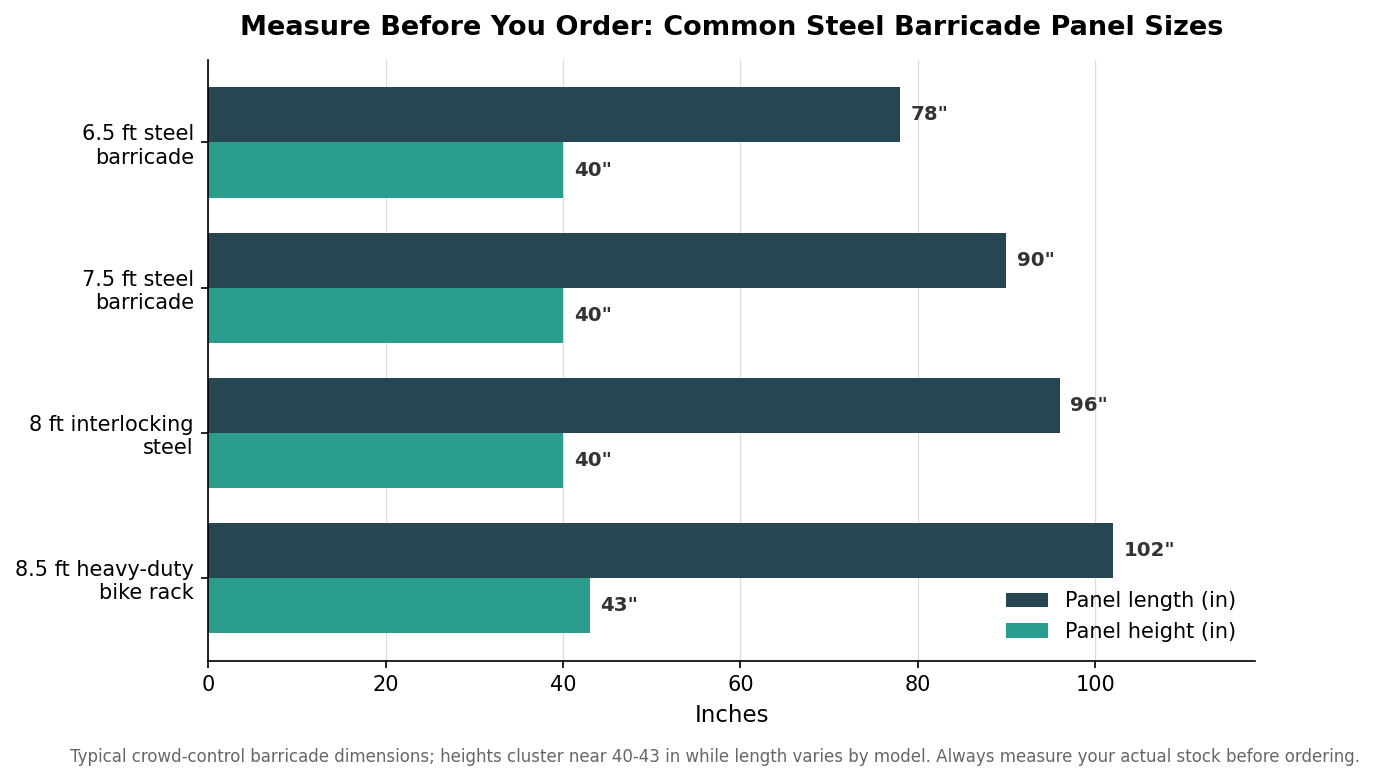
    Do not order to a category name. Crowd-control barricades come in several lengths that look identical in a listing, and a cover cut for the wrong one will not sit right. Steel interlocking and bike-rack barricades commonly run 6.5, 7.5, 8, or 8.5 feet long, while the height clusters in a narrow band around 40 to 43 inches. That means the length is where mistakes happen. Measure a representative panel end to end across the top rail, then measure the height from the top rail to where you want the cover to stop, and note whether you want the cover to hang to the feet or stop above them.
    Grouped horizontal bar chart of common steel barricade panel lengths and heights in inches
    Barricade heights cluster near 40 to 43 inches, but length varies from 78 to 102 inches, which is where sizing mistakes happen.

    If your inventory is a mix, measure each type and expect to order more than one size, because a single cover cannot fit both a 78-inch and a 102-inch panel without bagging on the shorter one. Also record the rail diameter and whether the barricade has a flat top or a looped bike-rack top, since that affects how a hem or pole pocket slips over it. When you send specs to a printer, give them the measured numbers rather than the manufacturer’s nominal size; galvanizing, welds, and model year all shift real dimensions by an inch or more.

    Pick the fit style that matches your look and budget

    There are three broad fit styles. A throw-over cover drapes over the whole barricade and secures underneath, which is fast to deploy and forgiving of small size differences but can wrinkle and move. A fitted jacket is sewn to the panel dimensions with a closure along the bottom or back, giving the tight, flat face that looks best in photos and on broadcast. A stretch fabric cover uses a spandex-type material with an elastic hem that pulls taut with no hardware, which looks clean and packs small but is less rugged than vinyl for long multi-day outdoor use. Match the style to the setting: a fitted vinyl jacket for a branded finish line that has to look sharp on camera, a stretch cover for an indoor expo, a throw-over for quick perimeter work where speed matters more than a perfect face.

    Choose the attachment that survives your event

    Attachment is where covers fail in the field, usually because someone specified the minimum. The common systems are hook-and-loop closures, grommets along the lower edge with zip ties or bungees, ball bungees, and elastic hems on stretch covers. For an indoor or low-wind setting, an elastic hem or a few hook-and-loop tabs are plenty. For anything outdoors, plan on grommets with zip ties or bungees at close spacing so the bottom edge cannot lift, and add ties at the ends where wind gets under the panel. Wind is the enemy of a solid vinyl face, because the cover acts like a sail; an open-weave mesh cover sheds much of that load and is worth choosing for exposed, breezy sites even though it prints slightly less vividly than solid scrim. Whatever you pick, over-specify the attachment rather than under-specify it, since re-securing covers mid-event is the most common day-of headache.

    Place the artwork where it actually reads

    Barricade covers are usually printed on 13-ounce scrim vinyl for lighter or shorter-term use or 18-ounce for heavy, repeated deployments, and you will choose between a standard logo zone, often around 24 inches high by 60 inches wide, and a full-panel wrap. The design mistake is centering everything and losing it behind a leaning spectator or a stack of gear. Keep the primary logo and any critical wording in the upper band of the panel, above roughly the 20-inch line, so it clears heads and equipment. Decide early whether you need double-sided printing: the crowd side and the outside of a barricade often face different audiences, and a single-sided cover leaves one of them blank. Double-sided costs more but is usually the right call for anything that separates two viewing areas, such as a stage front or a course.

    Do the quantity and lead-time math

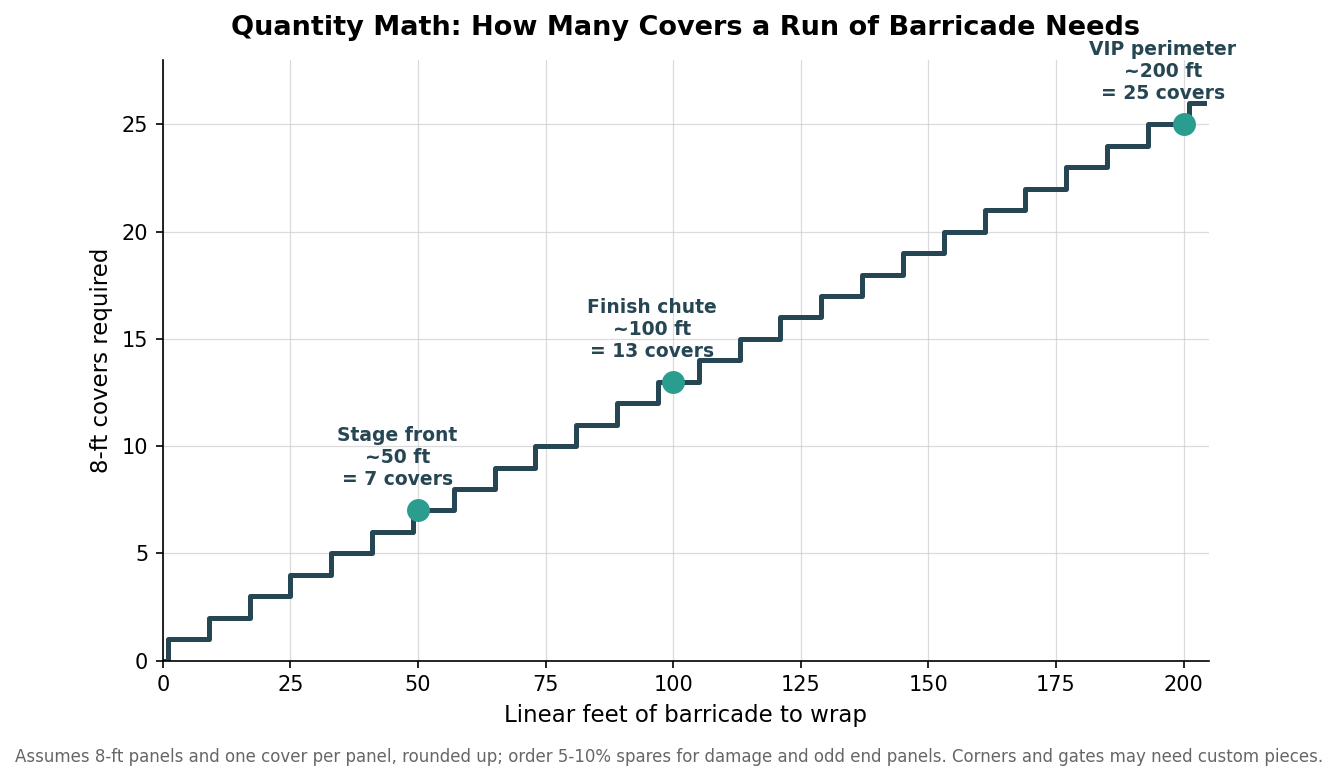
    Covers are ordered per panel, so estimating quantity is simple arithmetic once you know your linear footage: divide the run by the panel length and round up. A 50-foot stage front in 8-foot panels needs about seven covers, a 100-foot finish chute about thirteen, and a 200-foot VIP perimeter about twenty-five. The chart below shows the staircase for 8-foot panels.
    Step chart showing number of 8-foot barricade covers required for a given linear footage of barricade
    Divide linear feet by panel length and round up: about 7 covers for a 50-foot run, 13 for 100 feet, 25 for 200 feet.

    Order five to ten percent spares beyond the bare count. Panels get damaged, end sections come up short, and corners and gates often need odd pieces that do not fit a standard cover. On timing, custom printed vinyl covers commonly run about 7 to 10 business days in production after artwork approval, stretch fabric a little longer at 10 to 14, with rush options around 3 to 5 days for added cost, and entry pricing for a single custom cover often starts near $150 before volume brings the per-piece price down. Treat those figures as indicative, since they move with supplier, material, and season, and build in time for a proof and a physical sample. The discipline that prevents almost every fit problem is the same one that opened this guide: measure your real barricades, spec to those numbers, approve a sample on an actual panel, and only then commit to the full run.
  • Barricade Cover Materials: Scrim Vinyl, Mesh, and Knitted Fabric Compared

    Barricade Cover Materials: Scrim Vinyl, Mesh, and Knitted Fabric Compared

    Two barricade covers can carry the same artwork and behave completely differently on site: one stays crisp through a three-day festival in gusting wind, the other flogs itself to shreds by the second afternoon. The difference is almost always the substrate. Before you argue about color or price, it is worth understanding the material families a printed barricade cover can be built on, because that single choice sets your wind behavior, your lifespan, and whether the cover is a throwaway or something you reuse for years.

    The three substrate families

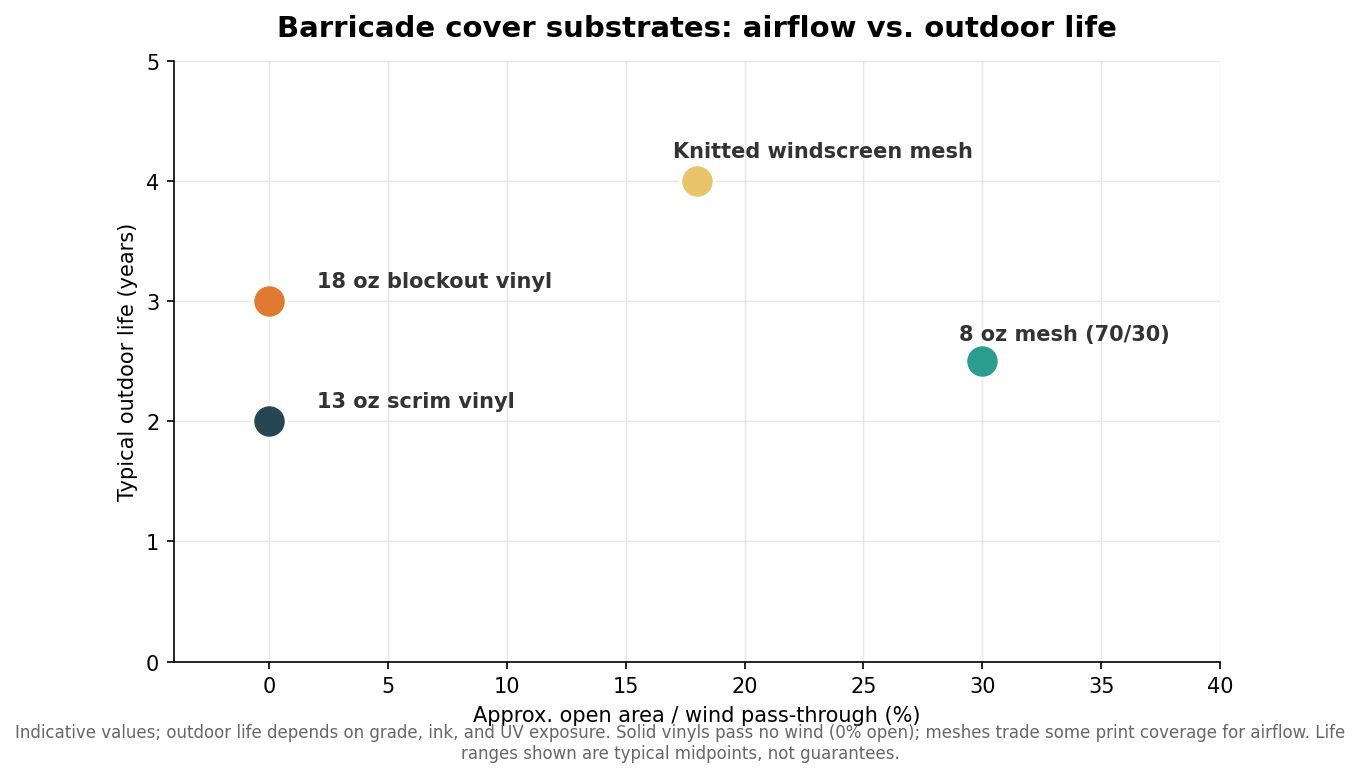
    Nearly every printed cover falls into one of three groups. Solid scrim vinyl is a coated PVC banner material that blocks wind and light completely and takes a dense, saturated print. Perforated mesh is the same idea with holes: a woven or knitted surface, part solid and part open, that lets air pass through. Knitted polyester fabric is a softer, dye-sublimated cloth that drapes over a barricade and is typically launderable and reusable. The chart below places the common options against the two variables that matter most outdoors, how much air they let through and how long they last.

    Scatter chart of barricade cover substrates plotting open area against typical outdoor life for vinyl, mesh, and fabric
    Solid vinyls sit at zero open area with bold print; meshes trade print surface for airflow (indicative values).

    Read that trade-off from left to right: the solid vinyls sit at zero open area, so they show the boldest graphics but catch the most wind, while the meshes give up some of that print surface in exchange for airflow. Nothing here is universally best; the right pick depends on where the barricade stands and for how long.

    Solid scrim vinyl: bold print, no airflow

    For indoor events, short outdoor runs, and anywhere wind is not the enemy, solid vinyl is the workhorse. Thirteen-ounce scrim vinyl is the common event weight: a matte, eco-solvent-printed banner material with vivid color, a typical outdoor life around two years, and a price that suits covers you may only run a handful of times. Step up to eighteen-ounce blockout vinyl when you need true opacity, a core layer stops light and any ghosting of what sits behind the barricade, and the heavier construction pushes usable life closer to three years for more permanent placements. Both share the same limitation: they pass no wind at all, so a large solid cover on an exposed barricade needs ballast or a rail that can take the load, or it becomes a sail. A bare bike-rack barricade is mostly open air and barely catches the wind; wrap it in solid vinyl and you have turned that open frame into a continuous panel, which is why event crews tend to reserve solid vinyl for indoor and short outdoor runs and reach for mesh the moment a job moves outside for more than a day or sits in an exposed spot.

    Perforated mesh and why open area matters

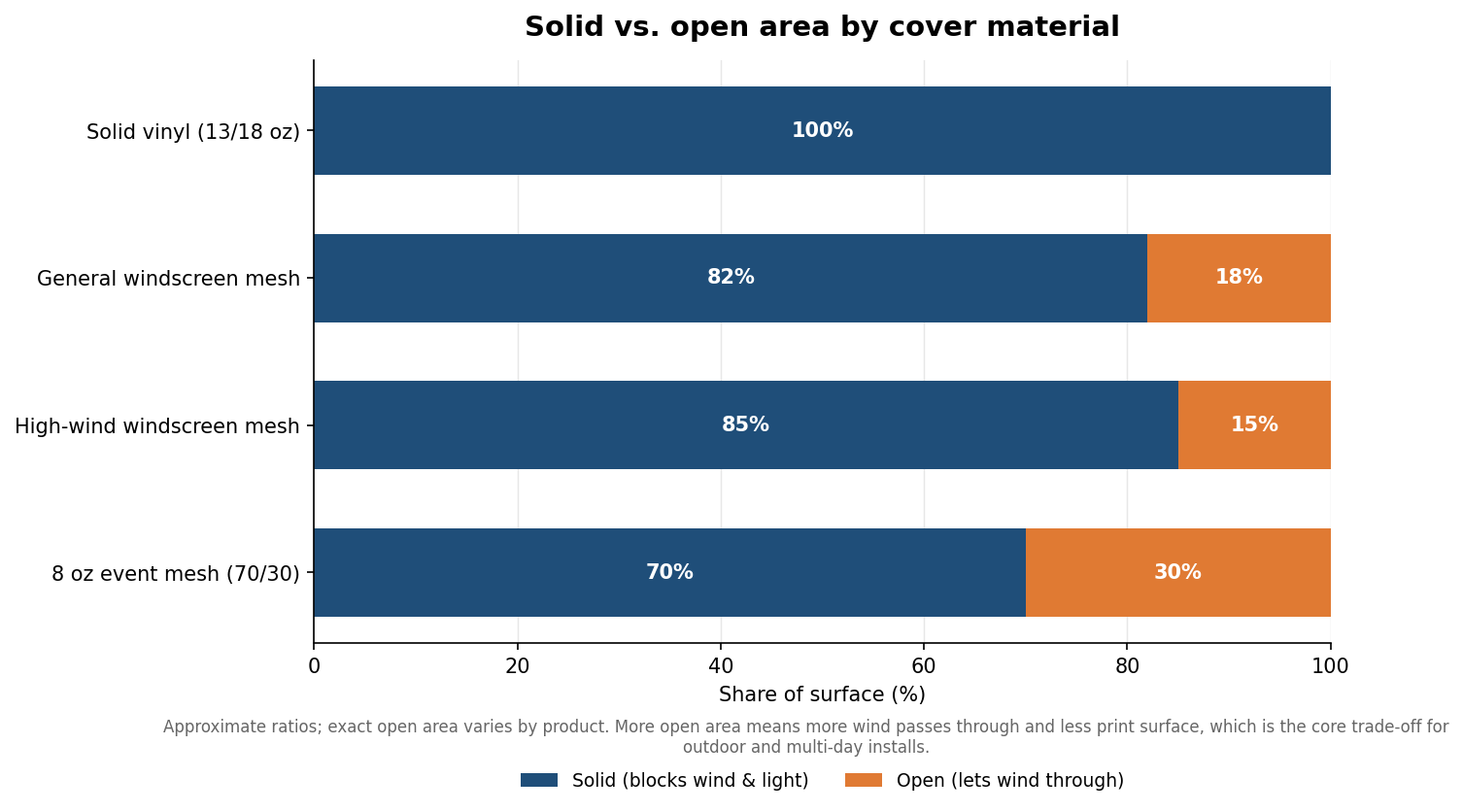
    Mesh exists to solve the wind problem. A common event mesh is described as a 70/30 construction, roughly seventy percent solid surface and thirty percent open area, which lets about a third of the wind pass straight through while still holding a readable print. Purpose-built windscreens push further, blocking anywhere from about eighty to ninety percent of the wind for general use and staying in the seventy-to-eighty-five-percent block range where high winds are the design concern. The rule of thumb is simple: more open area means less wind load and less ink coverage. The stacked view below shows how the solid-to-open ratio shifts across materials.

    Stacked bar chart of solid versus open area percentage across barricade cover materials
    The solid-to-open ratio is the core wind trade-off: more open area sheds wind but reduces ink coverage.

    Because a mesh cover breathes, it can run larger and longer on an exposed fence line than solid vinyl of the same size. Knitted polyethylene windscreen commonly lasts three to five years, and heavier vinyl-coated constructions longer still, though the print on any outdoor surface fades faster than the fabric fails. Attachment matters as much as the fabric here: grommets set every twelve to eighteen inches, laced with zip ties, bungees, or rope, keep the load spread, and a tension cable is worth adding on any run longer than about fifty feet.

    Knitted fabric covers: reusable and tailored

    The third family trades some ruggedness for finish and reuse. Dye-sublimated polyester knit produces a soft, edge-to-edge print with no seams in the image, and because the dye is infused into the fiber it survives repeated laundering. That makes fabric covers the choice for a brand that reuses the same barricades across a season of events, or for premium finishes where a fitted, wrinkle-shedding cover reads better than a flat banner. The compromises are cost per piece and durability against abrasion and sharp barricade corners, so fabric tends to belong to managed, reused fleets rather than leave-it-and-forget-it construction sites. It is also worth confirming how a fabric cover is cut and sewn: a fitted, pocket-and-flap cover that slips over the top rail and cinches at the base stays put far better than a flat panel zip-tied to the front, and that tailoring is a large part of what you pay for on the fabric side.

    Matching material to the job

    Line the choice up with the setting. For an indoor expo or a one-weekend activation, 13-ounce scrim vinyl gives the most color for the least money. For a permanent perimeter that must block sightlines, 18-ounce blockout earns its cost. For any exposed, multi-day, or windy outdoor line, choose mesh and size the open area to the wind you expect rather than defaulting to solid. And for a reusable, on-brand fleet you will deploy again and again, a dye-sublimated fabric cover pays back over its life. One spec sits above all of these and is chosen separately: if your venue requires a flame rating, confirm the material carries the certificate you need, since fire performance is a property of the specific product, not of the substrate family as a whole.

  • Custom Barricade Cover Mistakes That Waste Money and Fail Inspection

    Custom Barricade Cover Mistakes That Waste Money and Fail Inspection

    Custom barricade covers look like a simple print job: wrap a branded scrim over a crowd-control barrier and you are done. In practice, the covers that fail an event usually fail for the same handful of reasons, and every one of them is avoidable at the ordering stage. Below are the mistakes that quietly waste money, delay a build, or get a run of covers pulled by a fire marshal, along with what to do instead.

    Guessing the Barricade Size Instead of Measuring It

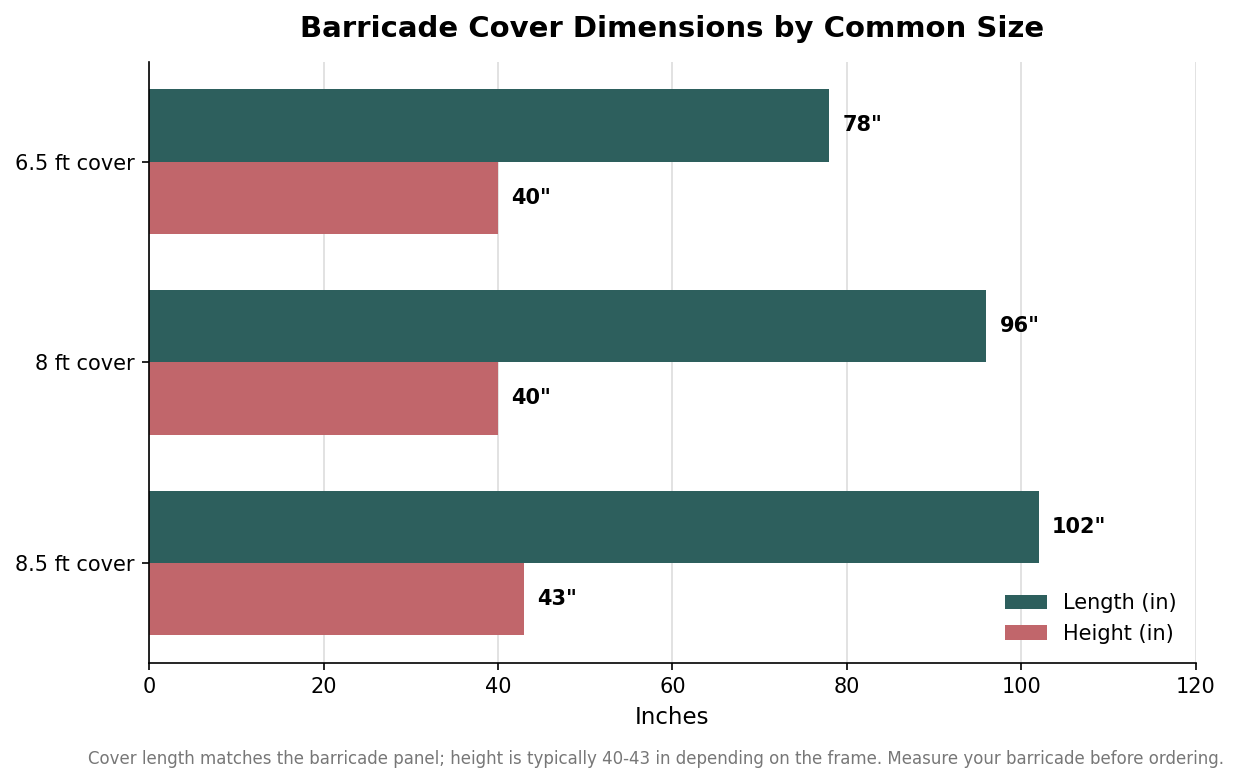
    The most expensive mistake is ordering to a nominal size rather than your actual barricade. Steel bike-rack barricades are commonly sold as 6.5-foot, 8-foot, and 8.5-foot units, and covers are cut to match, but the frame you own may not be the one the cover was designed around. A typical 8.5-foot steel bike-rack barricade runs about 102 inches long and roughly 43 inches tall and weighs in the low 40-pound range, while shorter frames sit closer to 40 inches tall. A cover cut two inches short will not seat over the top rail, and one cut too long will sag and flap.

    Horizontal grouped bar chart of barricade cover length and height in inches for 6.5, 8, and 8.5 foot sizes
    Covers are cut to the barricade panel; measure your frame before ordering to a nominal size.

    Measure the barricade you will actually use, not the catalog listing, and record the overall length, the height to the top rail, and the depth of the top rail the cover has to wrap. If your barricades come from more than one supplier or era, measure a sample of each, because a quarter-inch of frame variation across a hundred units becomes a visible problem on camera. When in doubt, most cover printers will fit to a photo and detailed measurements rather than a stock size, and that path is worth the extra step.

    Choosing Solid Vinyl When the Site Is Windy

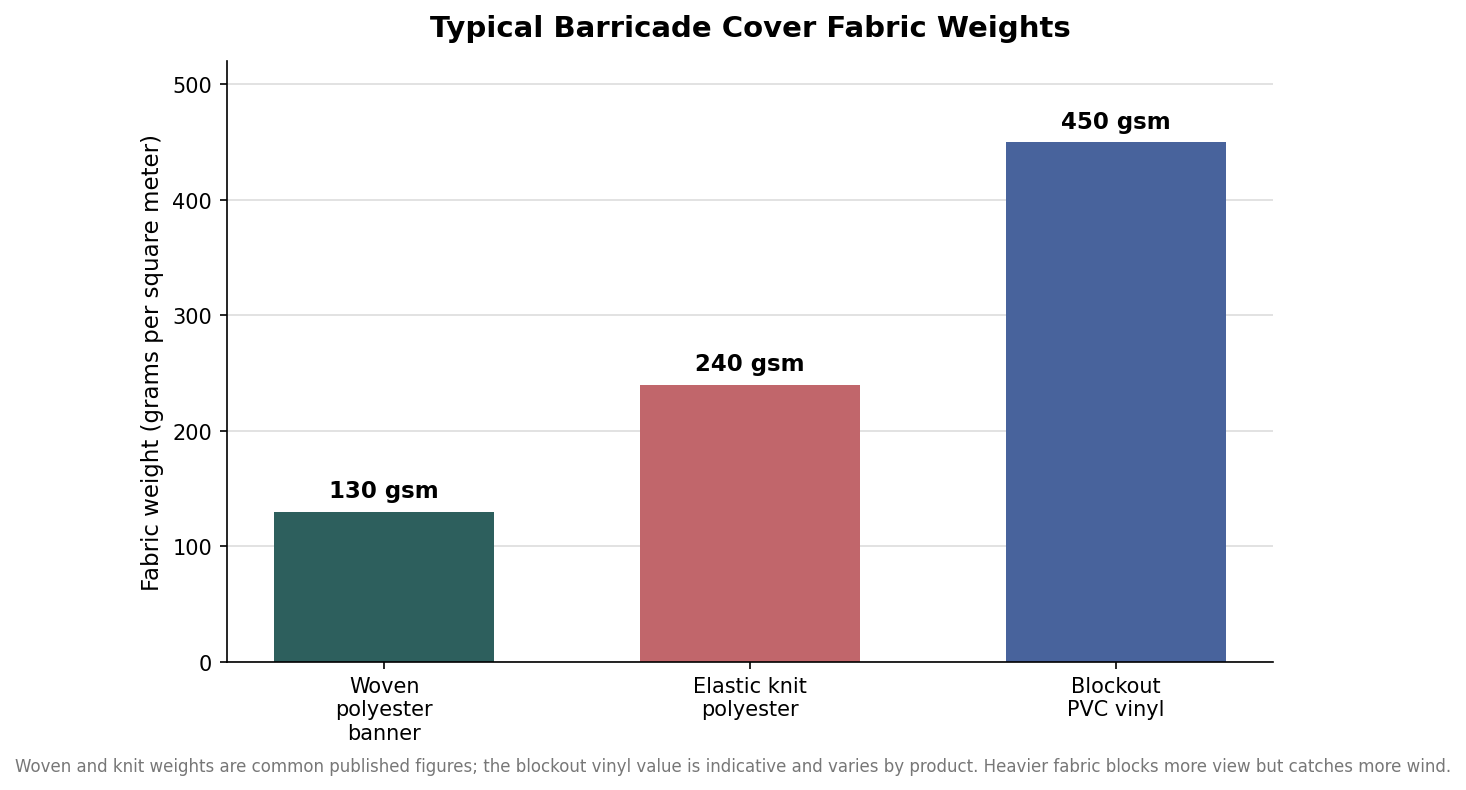
    Fabric weight and openness are the difference between a cover that survives a gusty afternoon and one that turns your barricades into sails. Lighter woven polyester banner material runs around 130 grams per square meter, elastic knit polyester covers are closer to 240 grams per square meter, and heavy blockout PVC vinyl is heavier still. Heavier, solid fabric blocks the view behind the barrier almost completely, which is exactly what a construction hoarding wants, but it also catches the most wind.

    Bar chart comparing barricade cover fabric weights in gsm for woven polyester, knit polyester, and blockout vinyl
    Heavier, more solid fabric blocks the view but catches more wind; match weight to the site.

    On an exposed outdoor site, a solid cover with no way to relieve wind can lift the barricade, drag it, or tear at the attachment points. The fixes are well established: choose a mesh or knit fabric that lets air pass, or specify wind slits cut into a solid cover so gusts vent instead of pushing. If full opacity is non-negotiable, then the barricades themselves need ballast or staking to hold the extra load. The mistake is pairing the most solid fabric with the most exposed location and no wind strategy at all.

    Under-Speccing Attachment and Reinforcement

    Covers do not usually fail in the field; the edges do. A cover held on by a couple of ties at the corners will billow in the middle and abrade at the contact points until it tears. Better covers use a combination of reinforced hems, grommets on a regular spacing, and elastic bungee balls or hook-and-loop straps that pull the fabric taut against the frame, and some add half-moon cutouts at the corners so crews can grip and stretch the cover into place. If your event runs multiple days, that reinforcement is what determines whether the covers look sharp on day three or shredded.

    Think about installation labor too, because a cover that fits perfectly but takes four people to wrestle on is a hidden cost at a large build. Sleeve-style covers that slide over the top rail install fast but need clear rail ends, while grommet-and-tie systems are more forgiving of odd frames but slower. Match the attachment method to how many barricades you are dressing and how much time the crew has before doors open.

    Ignoring the Fire Rating Until the Marshal Arrives

    Indoor and many permitted outdoor events require flame-retardant materials, and the relevant standard for decorative fabrics and films in the United States is NFPA 701. Order covers in a non-rated fabric for a venue that requires certification and you can lose the entire run at inspection, with no time to reprint. Many barricade cover fabrics are sold specifically as flame-retardant polyester for this reason, so the fix is simply to confirm the fire rating in writing before you order and to keep the certification documentation with the covers on site.

    Do not assume a fabric is rated because it is sold for events. Ask the printer to state the standard the material meets and to supply the certificate, and check your venue contract for the specific requirement, since some jurisdictions and venues have their own language on top of NFPA 701. This is a five-minute conversation at order time that prevents a total loss on show day.

    Treating Both Sides as an Afterthought

    Barricade covers are frequently seen from both sides, the public side and the interior of the secured area, yet buyers often design only the front. Full-color printing on both sides is widely available, and the back is prime space for sponsor logos, wayfinding, or a schedule that staff inside the perimeter actually need. If you only print one side, at least confirm what the blank back will look like from the crowd, because a plain white or seamed reverse facing a camera position undercuts the whole branded look.

    Plan artwork at the real finished dimensions with edge-to-edge coverage and a safe margin so text is not lost in the hem or behind the top rail. UV-resistant inks matter for anything living outdoors for more than a weekend, since unrated inks fade and chalk. Lock the fabric, the fit, the fire rating, and the two-sided artwork before you approve the proof, and the covers that arrive will be the ones you actually planned instead of a set of expensive lessons.

  • Barricade Covers, Wind, and Fire Rules: What to Specify

    Barricade Covers, Wind, and Fire Rules: What to Specify

    A printed barricade cover looks like a simple banner wrapped around a steel barrier, but two invisible forces decide whether it survives an event: the wind trying to tear it loose, and the fire code deciding whether it is allowed on site at all. Brand and design get most of the attention, yet a cover that ignores wind and flame rules can fail on the first gusty afternoon or get pulled by a fire marshal before doors open. Understanding both constraints up front lets you specify a cover that holds up and passes inspection, instead of learning the rules the hard way.

    Why wind is the first design constraint

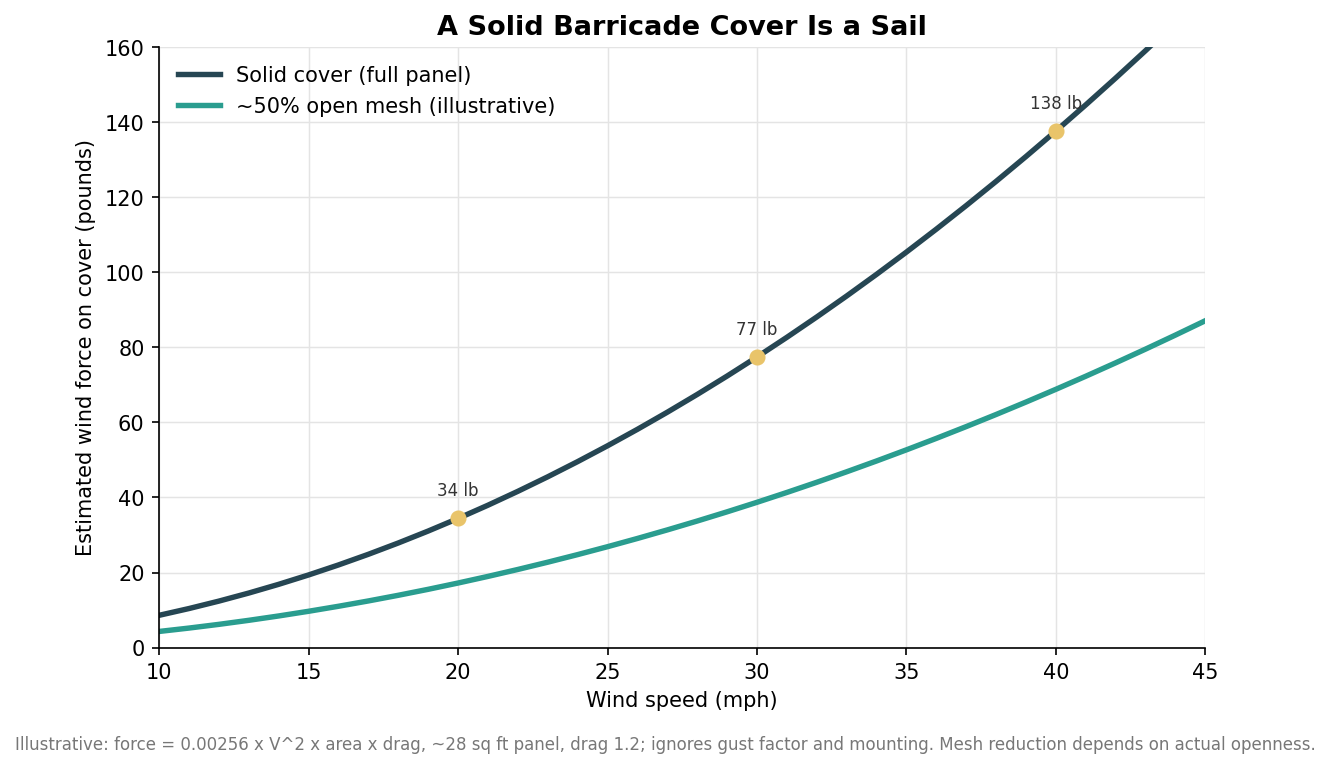
    A barricade cover is a broad, flat surface mounted on a light, freestanding frame, which is a nearly perfect description of a sail. The wind force on that surface climbs with the square of wind speed, so doubling the wind roughly quadruples the load. On a typical panel of about eight feet by three and a half feet, a solid cover can catch tens of pounds of force in a moderate breeze and well over a hundred pounds as gusts strengthen. The barricade itself weighs little and is not anchored, so beyond a certain point the wind either topples the barrier, drags the line, or rips the cover at its attachment points. The figures below are illustrative rather than an engineering certification, because real loads depend on gusts, mounting, and the exact fabric, but the shape of the curve is the point: force grows fast, and a solid cover feels it first.

    Line chart of estimated wind force on a barricade cover rising with wind speed, comparing a solid cover to a 50 percent open mesh cover
    Wind force rises with the square of wind speed; an open mesh cover carries far less load than a solid one.

    Mesh, openness, and airflow

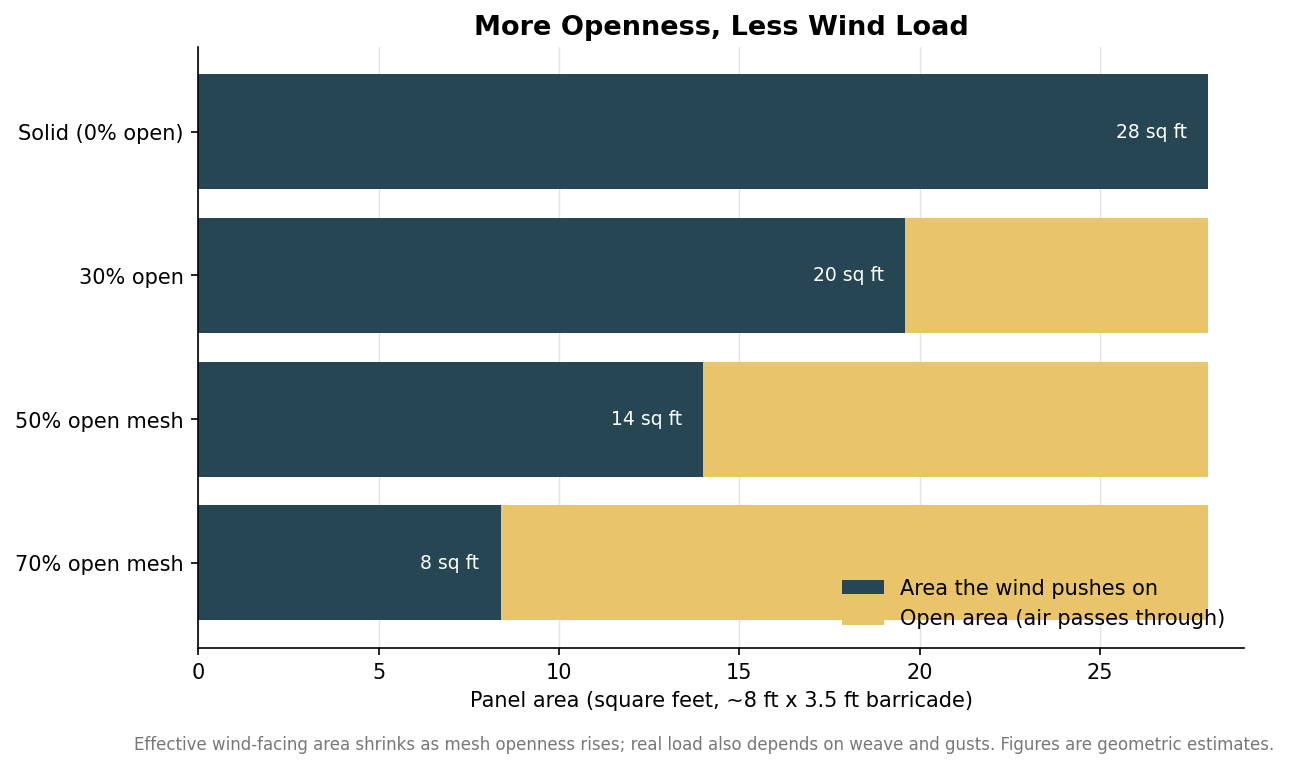
    The standard answer to wind is to let some of it through. Mesh fabric is woven with open space between the yarns so air passes rather than pushing against a solid wall, and the more open the weave, the less area the wind actually acts on. A cover that is fifty percent open presents roughly half the wind-facing area of a solid one, and a high-flow seventy percent mesh less still. That is why outdoor festivals and raceside barriers lean on mesh while indoor, low-wind settings can use denser solid fabrics that show color more vividly. The trade-off is print appearance: a more open mesh scatters the image slightly and lets background show through, so very fine detail and deep solid colors read better on tighter weaves. The practical middle ground for most outdoor branding is a mesh open enough to shed wind but tight enough to hold a clean logo, and reputable suppliers will quote an airflow or openness rating so you are not guessing.

    Stacked horizontal bar chart showing how the wind-facing area of a barricade cover shrinks as mesh openness increases from solid to 70 percent open
    A more open mesh reduces the effective area the wind pushes against on a standard barricade panel.

    Openness is a wind strategy, not a guarantee. Even a good mesh needs sound mounting, and in genuinely high winds the right call is sometimes to remove covers entirely rather than trust the fabric. Treat mesh as the measure that keeps ordinary breezes from becoming a problem, not as permission to ignore a storm forecast.

    NFPA 701 and the fire marshal

    The fabric also has to satisfy fire code, and for event textiles in the United States the reference standard is NFPA 701. It is a flame propagation test: a sample is exposed to a controlled flame, and to pass it must self-extinguish rather than keep burning, with the charred length staying under about six and a half inches and any after-flame lasting no more than roughly two seconds, and any drips must not continue to burn. Passing NFPA 701 does not make a fabric fireproof; it means the material resists igniting and does not spread flame, which is exactly what a fire marshal cares about in a crowd. Many venues and jurisdictions require NFPA 701 certification, often alongside a certificate for tents and structures, before they will issue a permit, and inspectors can ask to see documentation on site. Because the certificate travels with the specific fabric, the practical step is to require it in writing from your supplier and keep the paperwork with the covers, so a question at the gate does not become a shutdown.

    Sizing to standard barricades

    Covers only look sharp when they fit, and most crowd-control barricades follow a fairly standard footprint. Interlocking steel barricades commonly stand around forty to forty-three inches tall, with roughly forty-three inches (about 1.1 meters) being a widely shared height across rental fleets so that panels from different suppliers interlock. Panel lengths cluster around eight feet, with metric equivalents near two and two and a half meters also in circulation. Before ordering, measure the actual barriers you will dress, including the height to the top rail and the length between uprights, because a cover cut for a 1.1 meter barrier will sag or gap on a shorter economy model. If your inventory mixes styles, tell the supplier, since a universal-fit cover and a custom-fit cover are built differently and the tighter the intended fit, the more the exact numbers matter.

    Construction that survives a season

    Fabric choice and fit only pay off if the cover is finished to take abuse. The details that separate a season-long cover from a single-use one are sealed, double-folded hems that resist fraying, reinforced seams, and heavy-duty grommets rather than light stamped eyelets at the tie points. Those attachment points carry the wind load, so they are exactly where a cheap cover fails first. Ask how the edges are finished, how many attachment points run along each edge, and whether the corners are reinforced, because a cover that catches even moderate wind concentrates stress there. Ties, bungees, or hook-and-loop straps should be rated for outdoor use and spaced closely enough to keep the fabric from ballooning between them.

    Specifying a cover that passes

    When you request a quote, put the constraints on the page alongside the artwork. Name the environment, indoor or outdoor and the kind of wind you expect; ask for a specific mesh openness or airflow rating for outdoor use; require NFPA 701 certification with documentation supplied; give the measured barricade height and length and the fit you want; and confirm the hem, seam, and grommet construction. Those five items turn a vague banner order into a cover engineered for the conditions it will face. A cover chosen on print quality alone can still fail at the barrier or the permit desk, while one specified for wind and fire from the start does its branding job precisely because nobody has to think about it during the event.